Turf management has entered a new era: expectations keep rising, but budgets don’t. Labor is harder to find and more expensive to retain. Chemical programs are under pressure from both pricing and regulation. Water costs and restrictions are tightening in many regions. And meanwhile, the standard remains the same: deliver flawless, playable, consistent turf every day, in every season window that matters.
That’s the tension modern turf managers live with: reduce costs without sacrificing quality. Because on a golf course or a high-performance sports field, “cost cutting” isn’t neutral — it can quickly become visible. More weeds. More disease pressure. More complaints. More reactive work. And in the worst-case scenario: expensive renovations that wipe out years of careful planning.

The good news is that reducing turf management costs doesn’t have to mean doing less. It means managing smarter: focusing time, water, and products where they actually create value and stopping the costly habit of treating entire areas “just in case.”
In this guide, we’ll break down where turf budgets really go, identify the highest-impact levers to reduce spending, and show how precision approaches, from agronomic strategy to next-generation technology, can help you regain control and predictability, without compromising turf standards.
- Understand Where Turf Management Costs Really Come From
Before trying to reduce costs, it’s essential to be clear about where the money actually goes in a professional turf operation. Many cost-cutting attempts fail because they target the wrong areas or worse, they reduce visible quality while leaving structural inefficiencies untouched.
For most golf courses and sports facilities, turf management costs concentrate around four major pillars.
Labor is the largest and least flexible expense.
Wages continue to rise, skilled staff are harder to recruit, and seasonal peaks put constant pressure on teams. Routine, labor-intensive task suchs as blanket spraying, hand-weeding, or corrective work after missed problems consume hours without directly improving turf performance. When labor is scarce, inefficiency becomes expensive very quickly, forcing turf managers to rethink labor allocation and prioritize technologies that reduce repetitive or time-consuming activities, allowing staff to focus on tasks that directly impact field performance by improving playing conditions.
Chemical inputs: Rising cost and inefficient use
Herbicides, fungicides, and plant growth regulators are increasingly expensive, while the list of available active ingredients keeps shrinking. Traditional broadcast applications mean that most of the product (especially post-emergent herbicides) is applied to healthy turf, not to the problem itself. As a result, non-target exposure leads to phytotoxicity, places unnecessary physiological stress on desirable turf, and compromises visual quality and playing surface performance.
Water and energy costs continue to rise.
Even on well-designed irrigation systems, overwatering driven by uniform programs leads to higher pumping costs, disease pressure, and secondary chemical applications. What starts as a water issue often ends up inflating multiple budget lines.
Reactive repairs and emergency interventions are the silent budget killers.
Disease outbreaks, weed breakthroughs, or unexpected turf decline rarely appear overnight but when they do, they force urgent action. Extra labor, rushed applications, repeated treatments, and sometimes partial renovation quickly erase any savings made elsewhere.
The common denominator behind all these costs is uniform management. Treating entire fairways, roughs, or fields the same way, regardless of actual pressure, creates waste, increases labor, and reduces predictability. And unpredictability is expensive.
Reducing turf management costs doesn’t start with cutting inputs. It starts with stopping unnecessary work and understanding exactly where intervention truly creates value.
- Reduce Costs by Reducing Unnecessary Interventions
One of the fastest ways to overspend in turf management is to intervene too often and too broadly. Not because turf managers lack expertise, but because traditional practices are built around prevention by volume rather than prevention by precision. Not every weed justifies a treatment, and not every area requires the same level of intervention. Fairways, roughs, surrounds, and out-of-play zones do not carry the same performance or aesthetic thresholds, yet they are often treated as if they do.
A more cost-effective approach starts with defining tolerance levels. Accepting a limited presence of weeds in low-impact zones immediately reduces the need for full-area applications. This alone can eliminate multiple spray passes per season, saving product, fuel, and labor hours without affecting playability.
Moving away from calendar-based programs is equally critical. Fixed schedules assume uniform pressure that rarely exists in the field. Weed emergence, disease development, and stress patterns are localized and dynamic. When treatments are triggered by actual conditions rather than dates, unnecessary applications disappear, and so do their costs.
Reducing interventions also has a compounding effect. Fewer passes mean:
- Less soil compaction
- Less turf stress
- Lower disease pressure
- Fewer corrective treatments later in the season
In other words, doing less can actually stabilize turf health, making future interventions more targeted and predictable.
The goal isn’t to intervene less for the sake of savings. It’s to intervene only where it makes a difference. When treatments are justified, localized, and intentional, costs naturally come down, without compromising turf quality or control.
- Optimize Labor Through Smarter Allocation, Not Harder Work
Labor has become the most critical and constrained resource in turf management. Finding skilled staff is increasingly difficult, retaining them is costly, and asking teams to “work harder” is no longer a viable strategy. The real opportunity lies in how labor is allocated, not how much effort is demanded.
A large share of labor time is still absorbed by low-value, repetitive tasks: manual weeding, repeated blanket spraying, rescanning the same areas, or correcting issues that should have been addressed earlier. These tasks consume hours but add little long-term value to turf performance.
When labor is scarce, every hour must count. That means shifting staff away from mechanical execution and toward decision-driven work: monitoring turf health, adjusting agronomic strategies, and focusing on areas that truly affect playability and aesthetics.
There is also a hidden labor cost in inefficiency. Multiple spray passes, overlaps, and corrective treatments don’t just waste product, they multiply setup time, machine hours, and operator fatigue. Over a season, this quietly adds up to weeks of lost productivity.
Smarter labor allocation delivers several benefits at once:
- Fewer total interventions
- Shorter treatment windows
- Less seasonal overload
- Better morale and staff retention
- Reduced machine wear and maintenance requirements
Ultimately, reducing turf management costs isn’t about shrinking teams, it’s about freeing skilled people from tasks that technology and precision can handle better, so they can focus on what truly requires human expertise.
- Cut Chemical Costs Without Sacrificing Control
Chemical inputs remain one of the most visible and scrutinized lines in a turf budget and often one of the most misunderstood. Rising prices, shrinking product portfolios, and tighter regulations all push costs upward. Yet in many programs, the biggest driver of chemical spend isn’t the product itself, but how it’s applied.
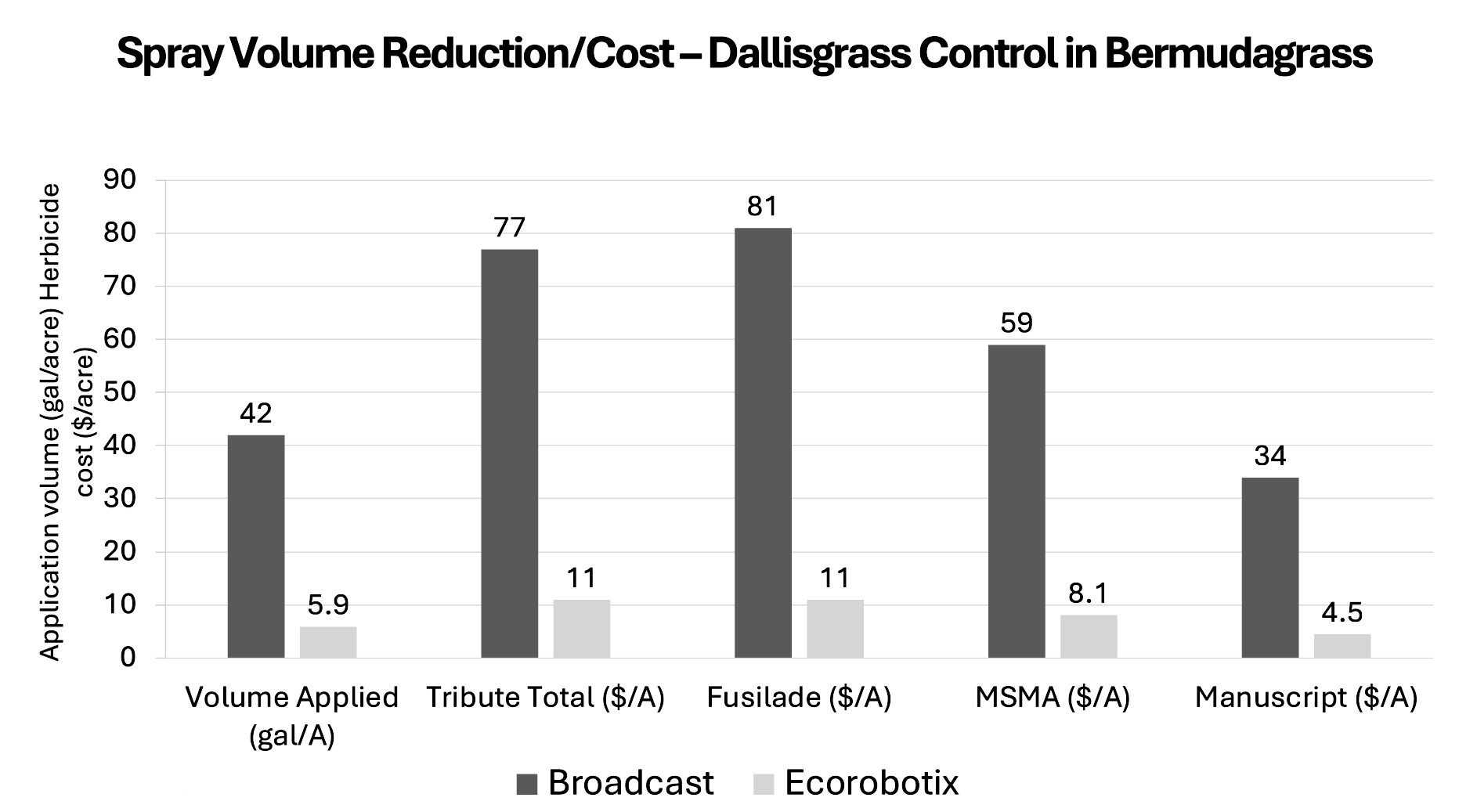
Traditional broadcast spraying is inherently inefficient. Large areas are treated uniformly, even though weeds or disease pressure are rarely uniform. Healthy turf receives product it doesn’t need, overlaps increase applied volumes, and margins of safety force managers to err on the side of excess rather than precision. The result: high product use without proportional gains in control.
Reducing chemical costs doesn’t mean losing authority over weeds or disease. In fact, better control often comes from treating less surface, not more. When applications are limited to the plants or zones that actually require action, efficacy improves while volumes drop.
Precision also expands strategic options. Targeted approaches allow turf managers to:
- Reserve chemistry for true problem areas
- Reduce reliance on repeated blanket applications across healthy turf
- Limit exposure of healthy turf, lowering stress and rebound pressure
- Stay ahead of resistance by applying the right solution in the right place
There is also a regulatory and reputational benefit. Lower active ingredient use simplifies compliance, improves reporting, and reduces the visible footprint of chemical treatments, increasingly important for clubs, municipalities, and sports organizations alike.
The key insight is this: chemical costs fall naturally when application becomes intentional instead of automatic. Control doesn’t come from spraying everywhere. It comes from knowing exactly where intervention matters and acting precisely there.
- Anticipate Problems Instead of Paying for Emergencies
Emergency interventions are among the most expensive events in turf management, not because they happen often, but because when they happen, they happen fast. Disease outbreaks, aggressive weed spread, or unexpected turf decline rarely allow for calm planning. They demand immediate action, extra labor, repeated applications, and sometimes visible disruption to play.
Yet most of these emergencies are not sudden. Weeds reappear in the same zones. Diseases follow recurring patterns linked to microclimate, soil conditions, or traffic. When these signals are missed or treated uniformly, turf managers end up paying repeatedly for the same problems, season after season.
Anticipation changes that equation completely.
By identifying where issues persist and how they evolve over time, interventions can shift from reactive to proactive. Localized action early in the cycle is almost always cheaper than broad corrective treatments later. It also reduces the need for peak-season firefighting, when labor is stretched and mistakes are costly.
The financial impact is significant:
- Fewer emergency spray passes
- Less overtime labor
- Lower risk of turf loss or renovation
- More predictable annual budgets
Anticipation also protects reputation. Turf issues addressed quietly and early rarely draw attention. Emergencies, on the other hand, are visible to players, members, governing bodies, and sometimes the public.
In cost terms, predictability is one of the most valuable assets a turf manager can have. When problems are anticipated, costs become planned. When they aren’t, costs multiply.
- Precision Technology as a Cost-Control Tool (Not a Gadget)
Technology has become a loaded word in turf management. Too often, it’s associated with complexity, disruption, or tools that look impressive but fail to deliver real-world value. For professional turf managers, the question isn’t whether technology is innovative, but whether it makes daily operations more efficient, improves playing conditions, and helps teams maintain consistent turf quality with the resources they have available.
Precision technology earns its place only when it replaces waste.
The core shift is simple: moving from broadcast management to site-specific management. Instead of treating entire fairways or fields as a single unit, precision approaches focus on what truly requires attention, a specific weed, a localized infestation, a recurring stress zone.
When applied correctly, precision changes the economics of turf care:
- Treated surface area decreases dramatically, reducing the risk of turf injury
- Product volumes and cost drop accordingly
- Fewer passes are needed to achieve control
- Labor time per hectare goes down
- Using premium products that would otherwise be restricted to small areas in the fields becomes economically feasible.
This is not about adding another layer of work. It’s about removing unnecessary work that has been accepted for decades as “normal.” Blanket spraying, overlapping passes, and preventive treatments applied everywhere were once the only option. Today, they are often the most expensive option.
Precision technology should also be evaluated on what it prevents. Missed areas, over-application, inconsistent results, and reactive follow-up treatments all carry a cost even if they don’t appear immediately on an invoice. By increasing consistency and accuracy, precision tools reduce variability, and variability is expensive.
When technology is approached as a cost-control instrument, not a novelty, it becomes a strategic asset. It allows turf managers to do exactly what they’ve always aimed for: apply the right solution, at the right place, at the right time, while spending less to achieve it. The right technology also translates into a stronger overall experience for members that can even drive revenue up.
ALBA: Turning Cost Reduction Into a Strategic Advantage
Up to this point, one principle has remained constant: cost reduction follows precision. When interventions are localized, justified, and predictable, spending naturally comes down. ALBA was designed specifically to make that level of precision achievable at scale in professional turf management.
Developed by Ecorobotix, ALBA is an ultra-high-precision, plant-by-plant sprayer built for golf courses, sports fields, and high-value turf areas. Instead of treating surfaces uniformly, ALBA identifies weeds individually in real time and applies product only where action is required down to a few square centimeters.

This approach directly addresses the main cost drivers turf managers face today:
- Chemical costs drop dramatically
By eliminating blanket spraying, ALBA typically reduces herbicide use by 70 to 95%, depending on infestation levels. Healthy turf is left untouched, and product is reserved exclusively for weeds - Labor efficiency improves immediately
Fewer passes, fewer trips refilling tank, and fewer corrective treatments mean less time spent spraying, spot spraying and hand-weeding, freeing skilled staff for higher-value agronomic work. - Interventions become predictable
ALBA records where weeds are treated, creating the foundation for anticipation rather than reaction. Persistent zones can be addressed early and locally instead of triggering full-area emergency responses later. - Turf quality and reputation are protected
Treatments are silent, drift-free, and invisible to players and neighbors. Precision reduces turf stress, supports long-term surface consistency, and aligns with increasingly strict environmental expectations.
Importantly, ALBA is not a cost-cutting shortcut. It is a control tool, one that allows turf managers to maintain high standards while spending less on inputs, labor, and reactive fixes. In that sense, cost reduction becomes a by-product of excellence, not a compromise.
Spend Less by Managing Smarter
Reducing turf management costs isn’t about lowering expectations or doing less work. It’s about stopping unnecessary work, unnecessary applications, unnecessary passes, unnecessary stress on turf and teams.
When interventions are intentional, localized, and anticipated, budgets stabilize. Labor becomes more effective. Chemical use drops without loss of control. And turf quality becomes easier to maintain, not harder. Precision is no longer a future concept in professional turf management. It is the most reliable path to balancing performance, predictability, and profitability. With tools like ALBA, turf managers can meet rising expectations while keeping costs firmly under control and do so with confidence.