How pre-emergence herbicides prevent weeds
Pre-emergence herbicides create a chemical barrier in the top 1–2 inches of soil that prevents germinating weed seeds from completing root and shoot development. Instead of killing established plants or dormant seeds, the active ingredients disrupt cell division or root-tip growth as the seedling tries to emerge, so the young weeds never break through the soil surface. Examples on the market include granular and spray options; product listings show formulations such as Scotts Halts Crabgrass and Grassy Weed Preventer (Pendimethalin) and The Andersons 0.48% Barricade (Prodiamine). For landscape beds and ornamentals, many professionals also choose Preen Extended Control (Trifluralin & Isoxaben), Snapshot (Trifluralin & Isoxaben), or Surflan (oryzalin). Water-in and disturbance: For the barrier to form properly, the application must be followed by rainfall or irrigation (typically ½ inch of water within a few days). Inadequate watering or later soil disturbance (such as aeration, raking, or heavy foot traffic) can break the barrier and allow weed seeds to germinate. Efficacy factors: Timing, application rate, rainfall/irrigation, soil organic matter content, and mulch depth all affect performance. Some active ingredients, such as pendimethalin (available as Pendulum 2G granular or AquaCap spray), come in both granular and liquid formulations.
When to apply pre-emergent herbicide: soil temperature + seasonal timing
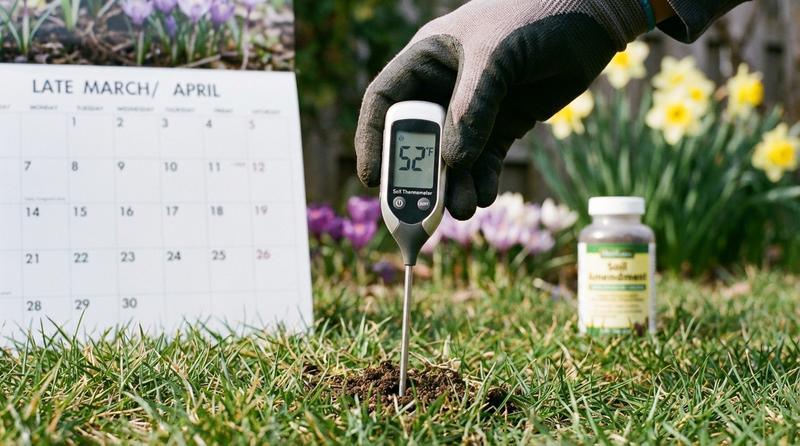
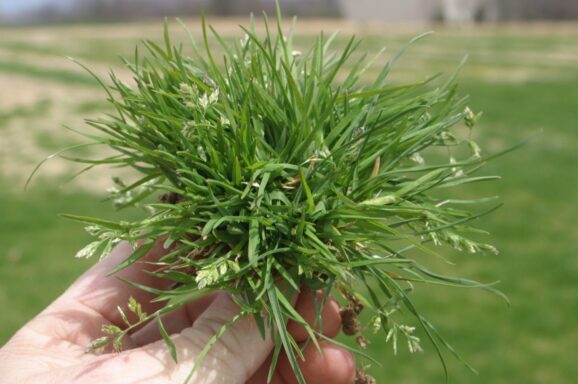
Summer annual weeds: Summer annual weeds such as crabgrass, goosegrass, foxtails, and broadleaf species like spurges and oxalis germinate in spring when soil temperatures reach and remain around 55–60 °F (13-16 °C) (often signaled by forsythia bloom in the Mid-Atlantic USA). These weeds complete their life cycle, germinating, growing, seeding, and dying within one growing season. A timely spring pre-emergent application (late February to mid-March, depending on the zone) creates the necessary barrier before germination begins. Many of the same active ingredients used for annual bluegrass (Poa annua) (e.g., prodiamine, dithiopyr, pendimethalin) also provide excellent control of these summer weeds when applied at the correct rate and timing. A split application (initial + follow-up 6–8 weeks later) can extend protection through the peak germination window. Winter annual weeds: Winter annual weeds, such as annual bluegrass, chickweed, henbit, and purple deadnettle, germinate in late summer or early fall as soil temperatures drop below ~70 °F (21 °C). These weeds overwinter as small plants, grow actively in cool weather, and produce seeds in spring before dying off in early summer. Many are prolific seed producers (for example, a single annual bluegrass plant can yield hundreds to over 2,000 seeds), which allows them to quickly build a large soil seed bank.
Fall pre-emergent applications (typically mid-September to early October) in most regions are essential for prevention. Spring applications will not control them, as germination has already occurred the previous fall.
Disclaimer: The inclusion of commercial product names in this guide does not represent any endorsement or recommendation of those products over others. Always read and follow the product label carefully for specific application rates, site uses, species tolerance (especially on turfgrasses and ornamentals), safety precautions, and local restrictions.
How to choose the best pre-emergent herbicide product (selector framework)
- Target Weeds. Choose a product that is effective against the weeds you want to target. For crabgrass-focused control, select a product containing pendimethalin (e.g., Scotts Halts Crabgrass and Grassy Weed Preventer or Pendulum 2G/AquaCap) or dithiopyr (e.g., LESCO Dimension 19-0-6). For mixed grassy and broadleaf weeds, consider prodiamine (e.g., The Andersons 0.48% Barricade or LESCO Stonewall). Remember: Spring applications target summer annual weeds (crabgrass, goosegrass, foxtails, spurge, oxalis), while fall applications are required for winter annual weeds such as annual bluegrass.
- Site. Match the product to the application area. Lawns, landscape beds, and areas around ornamentals often require different formulations and labels. Some pre-emergents are safe for turf but not for beds; others are specifically labeled for ornamentals. Always read the label for approved uses and plant safety. Popular options for landscape beds and ornamentals include Preen Extended Control, Snapshot (trifluralin + isoxaben), and Surflan (oryzalin).
- Grass Type and Tolerance. Identify your turf species and choose a product labeled safe for it. Warm-season and cool-season grasses have different tolerances, so make sure the product you select is safe on the type of turf you have.
- Formulation (Granular vs. Spray). Decide based on ease of use, available equipment, and coverage needs. Granular products are popular with homeowners and contractors for uniform application and are often available on fertilizer carriers. Examples include Guardian 13-0-10, Safeguard 0-0-7, LESCO Dimension 19-0-6, and LESCO Stonewall (0.43% or 0.37% prodiamine) in 50-lb bags. Sprayable formulations (e.g., Pendulum AquaCap) can offer more precise or flexible application.
- Seeding/Overseeding Plans. If you plan to seed or overseed, select a product with clear seeding interval instructions on the label (some have longer wait times than others). Always follow label directions for rates, water-in requirements, and reapplication.
Comparison table: common preemergence actives and where they are used
| Active | Formulation examples | Primary weeds | Typical residual (high-level) | Best use sites | Key cautions (label) |
| Prodiamine | LESCO Stonewall (0.37% or 0.43% in 50-lb bags), The Andersons 0.48% Barricade, Barricade 65 WDG or 4FL | Crabgrass, other grassy weeds and some broadleaf weeds | Generally within the common 2-6 month range (product dependent) | Lawns, scene beds (where labeled) | Follow label for rates; water-in to form a barrier in the top 1-2 inches of soil; seeding restrictions apply |
| Pendimethalin | Scotts Halts Crabgrass & Grassy Weed Preventer, Pendulum 2G (granular), Pendulum AquaCap (sprayable) | Grassy weeds (crabgrass, goosegrass, foxtails) and some broadleaf weeds | Typically 2-4 months, varies by formulation | Lawns, ornamentals, beds where labeled | Avoid soil disturbance after application; check turf safety and allowable uses on label |
| Dithiopyr | LESCO Dimension 19-0-6 (and other Dimension blends), Dimension 2EW (sprayable) | Crabgrass, some annual grasses; early post-emergent activity on small seedlings | Often 2-6 months depending on rate | Lawns and beds listed on label; useful where light fertilization is combined | Observe label for seeding intervals; check ornamental tolerance if using near flowers/shrubs; some early post-emergent benefit on tiny seedlings. |
Dinitroaniline family (oryzalin e.g., Surflan) | Surflan (oryzalin) examples | Many annual grasses and certain broadleaf seedlings | Falls within the 2-6 month general window | scene beds, around ornamentals (per label) | Brand/active differences affect species safety; always check label for plant lists and maximum annual rates |
Trifluralin + Isoxaben | Preen Extended Control, Snapshot (granular or spray options) | Grassy and broadleaf weeds in beds | Generally 2–6 months (product- and rate-dependent) | Primarily landscape beds and ornamentals | Excellent for beds but check individual ornamental tolerance; some formulations are not for use on turf; read label for application method and plant safety. |
Note: verify product labels for exact rates, timing, and site restrictions before applying.
Season-long weed control: For season-long weed control and to get the most out of your lawn and ornamental beds, pre-emergent herbicides are only one part of the process. One of the most effective ways to manage weeds is through plant competition. In lawns, healthy and dense turfgrass can suppress weeds better than almost any herbicide by limiting the space, light, water, and nutrients available for their growth.
This is where the concept of Integrated Pest Management (IPM) becomes especially important. IPM emphasizes prevention first, while also combining cultural practices such as proper mowing, balanced fertilization, adequate irrigation, and routine monitoring. Together, these practices help maintain turf that is healthy, vigorous, and resilient to weed invasion. When used as part of a broader management strategy, herbicides can be more effective and may even be needed less often over time.
The ALBA Ultra High Precision Sprayer a Game Changer in Pesticide Applications
While pre-emergence herbicides are highly effective at preventing many annual weeds, they have important limitations. They do not control established perennial weeds such as dallisgrass, nimblewill, orchardgrass, or unwanted bermudagrass, nor do they effectively manage weeds with deep taproots, rhizomes, or tubers like dandelions, white clover, ground ivy, and sedges. Even under ideal conditions, some weeds will break through the herbicide barrier due to factors like heavy rainfall, soil disturbance, high weed pressure, or timing issues.
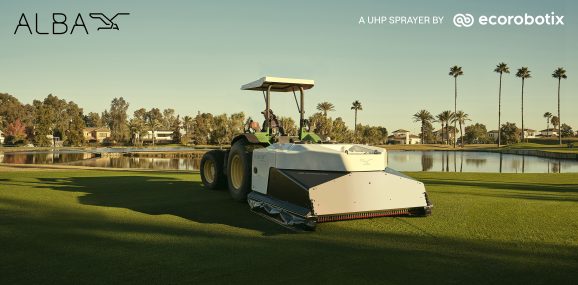
When pre-emergent herbicides fall short for any reason, post-emergent herbicides become necessary. The timing of these applications depends on your personal tolerance for weeds and other site-specific factors. Traditional blanket spraying remains the standard practice, but most of the herbicide ends up on healthy turf rather than the targeted weeds. A more precise, targeted approach has long been desired, yet until recently, the only real option was time-consuming and expensive manual spot treatment. Thanks to Ecorobotix's plant-by-plant technology, this is changing. The new ALBA Ultra High Precision Sprayer is an innovative solution designed for turf areas such as golf courses, athletic fields, sod farms, and large landscapes. It eliminates wasteful applications by identifying weeds in real time and spraying only where needed.
The ALBA, powered by Ecorobotix’s Plant-by-Plant technology, offers numerous advantages for pesticide application in turfgrass. By targeting only the weeds, it significantly reduces the cost of chemical applications and improves turf safety because the desirable grass is left untreated. Additionally, this precision approach allows the use of more premium chemistries, including certain organic non-selective herbicides. Overall, the ALBA represents a major advancement that promises to revolutionize weed and pest management in turfgrass systems, potentially reducing the long-term reliance on pre-emergence herbicides in the years ahead.
FAQ: Pre-emergent herbicide questions (PAA-focused)
What is a pre-emergent herbicide?
We define preemergence herbicide as a product applied to soil before weeds appear; as (Lawn Doctor) summarizes, "Pre-emergent herbicides are products that are applied to the soil before weeds start to emerge." Vous l’appliquez préventivement pour bloquer les semences.
How does it work?
They form a chemical barrier in the top 1-2 inches of soil that stops seedlings from completing germination; They work by creating a barrier in the soil that prevents weed seeds from germinating. This is a pre, not post, control.
When should you apply?
Apply before target weed germination; for summer annual weeds, applications usually go out when soil temperature is between 55–60 °F (13-16 °C). For annual bluegrass, fall prevention is the way to go, mid-September- early October. Remember that spring applications will NOT control it. Follow product timing on the label.
How long does it last?
Residual activity of pre-emergence herbicides varies by active ingredient, application rate, soil type, temperature, and rainfall, but typically lasts 2 to 6 months under normal conditions. For season-long weed control, use an integrated pest management (IPM) approach that combines pre-emergent herbicides with strong cultural practices such as proper mowing, watering, mulching, and fertilization as the foundation of your program.
Granular vs liquid - which when?
Granular formulations are often more convenient for homeowners and contractors because they are easy to spread with a broadcast spreader and have lower drift risk around ornamentals. Liquid sprays, however, usually provide more uniform coverage and better penetration. Pendimethalin is available in both forms, as the granular Pendulum 2G and the sprayable Pendulum AquaCap. Choose granular for simplicity and safety in landscape beds; choose liquid when maximum uniformity is needed.
Safe around ornamentals?
Use only products labeled for beds and ornamentals and follow label instructions; some formulations are labeled for scene beds when specifically listed.
Can it be used in beds?
Yes, but only if the product label specifically allows use in landscape beds or around ornamentals. Some pre-emergent fertilizer blends, such as Guardian 13-0-10, LESCO Dimension 19-0-6, and Safeguard 0-0-7, are labeled for both turf and beds where permitted. Always check the label for approved sites and plant tolerance.
Does it kill existing weeds?
No - preemergent herbicides prevent new seedlings from emerging but do not kill established weeds above ground.
Can you seed after application?
Seeding depends on residual and label intervals; always check the product label before seeding to know allowable wait times.
What’s best for crabgrass?
For reliable crabgrass prevention, choose a pre-emergent labeled for crabgrass. Popular choices include prodiamine products like LESCO Stonewall (0.37% or 0.43%) and The Andersons 0.48% Barricade, as well as pendimethalin products like Scotts Halts or Pendulum 2G. LESCO Dimension 19-0-6 (dithiopyr) is also a strong option, especially in fertilizer blends. Apply in early spring for best results.