Herbicide programs that held Poa annua for years are breaking down on courses across the country. Poa annua herbicide resistance now overlaps 8 of the 12 herbicide modes of action registered to control annual bluegrass on US turf, according to the United States Golf Association (USGA) Green Section Record [1]. A mode of action is the specific biological process a herbicide attacks inside the plant, and once a weed population survives that process, every product built on the same mode fails with it.
Indaziflam was the first cellulose biosynthesis inhibitor in any plant to lose efficacy on Poa annua [2], and a 2025 Oregon study confirmed indaziflam-resistant populations surviving up to 99 times the lethal dose that kills a normal plant [3]. This guide explains the biology behind that adaptation, the map of modes of action under pressure, how researchers confirm resistance in the lab, and the integrated program superintendents can run to slow it down.
Key takeaways
- Poa annua ranks third among the world's most herbicide-resistant weed species, with documented resistance to at least nine modes of action [4].
- Of the 12 herbicide modes of action registered for annual bluegrass control on US turf (4 preemergence, 8 postemergence), 8 now have confirmed resistant populations [1].
- Indaziflam resistance was first documented in southeastern US golf turf in autumn 2015 [2], then confirmed for both preemergence and early-postemergence use in Oregon [3].
- A single resistant population can survive eight modes of action at once, including the preemergence anchor and the non-selective cleanup tools [2].
- The diagnostic threshold for declaring a population resistant is a resistant-to-susceptible dose ratio above 2x against a known susceptible reference plant.
Why Poa annua evolves resistance so readily
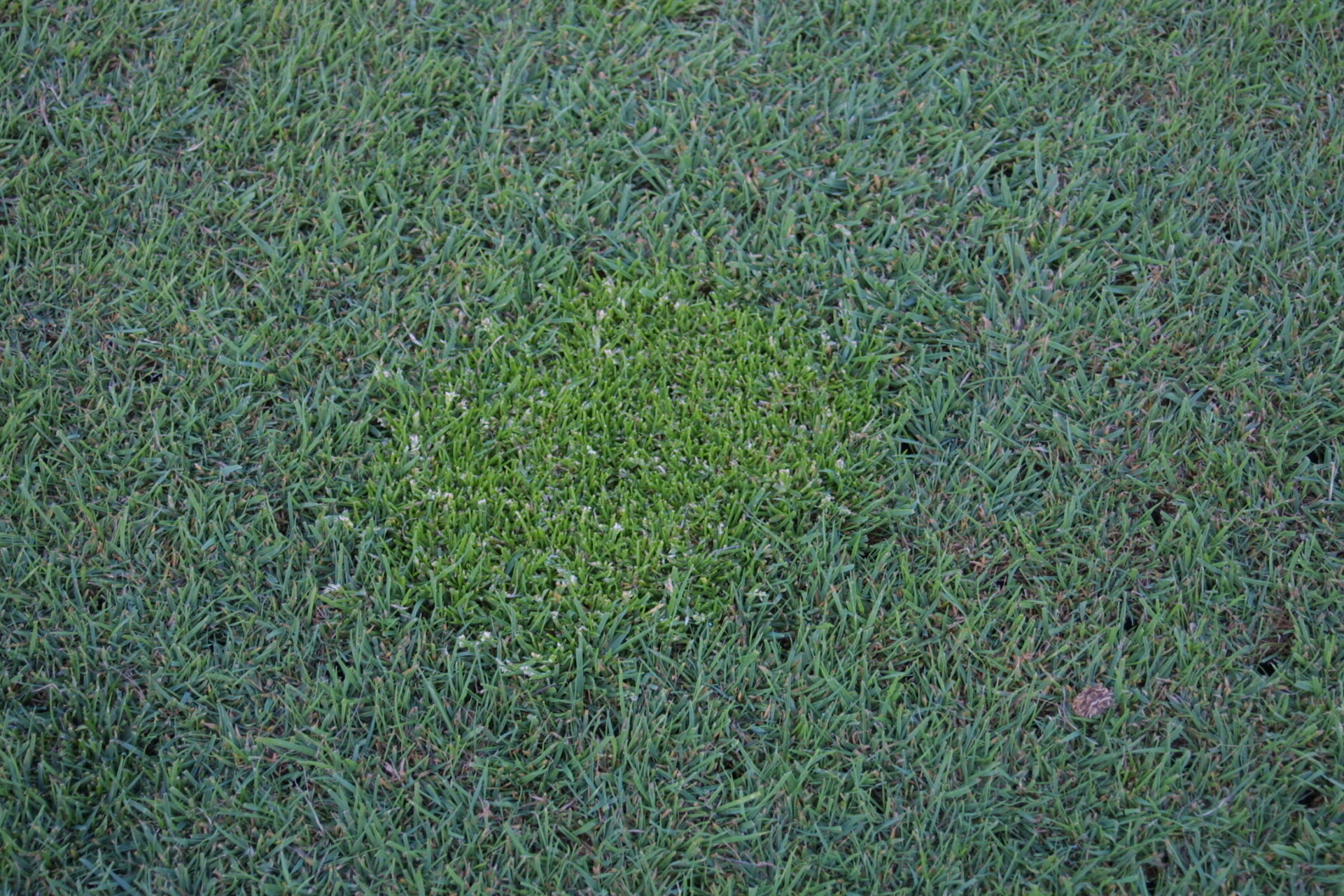
Annual bluegrass evolves resistance faster than almost any turf weed because its genetics and its life cycle both defeat fixed programs. The species is allotetraploid, which means it carries the combined genetic library of two parents, Poa supina (cool, alpine origins) and Poa infirma (dry, Mediterranean origins). That double library underwrites its phenotypic plasticity: the same weed shifts from an annual to a perennial habit under intensive mowing, irrigation and growth-regulator programs, then reverts to an annual phenotype within a single season once conditions ease.
Three operational levers compound the biology:
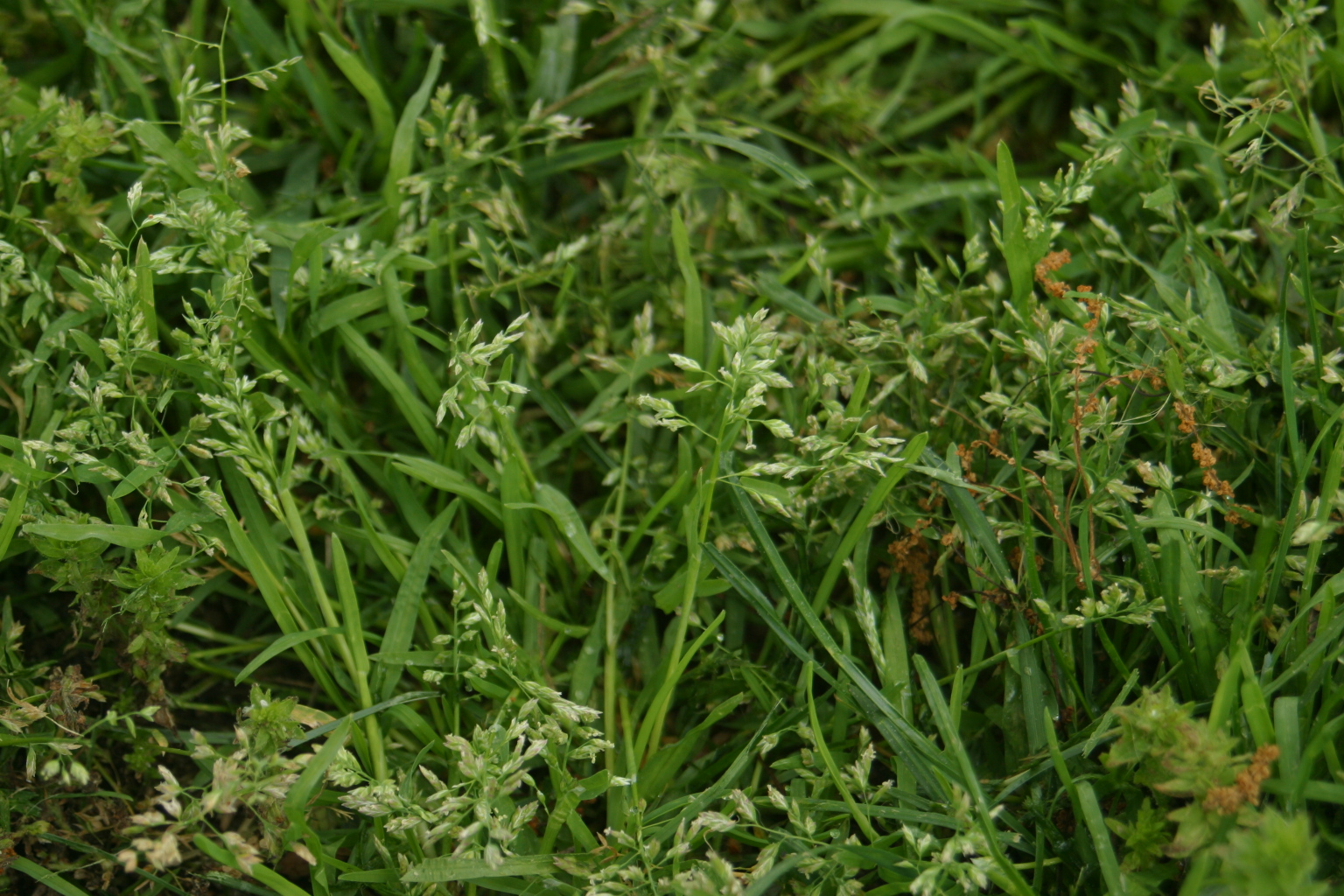
- Prolific seed production at putting-green heights refills the seed bank every spring and fall, faster than a single herbicide pass can deplete the surviving cohort.
- Staggered emergence pulses, tied to falling fall soil temperatures and to spring temperature swings, spread the at-risk window across months, so a single application catches only part of the population.
- Seedling survival under defoliation and traffic gives the rare resistant plant enough time to set seed before the next mowing cycle disrupts it.
Selection pressure does the rest. Where the same mode of action is applied year after year on the same fairway, the resistant plant that survives at the labeled rate sets seed into a seed bank that already favors it, and the share of resistant plants climbs within a few seasons. The math is unforgiving on heavily managed turf, because the same conditions that produce tournament-grade playability, namely repeated inputs and uniform stress, are exactly the conditions that accelerate resistance selection on annual bluegrass.
Modes of action: the operational grammar of resistance
Rotating across modes of action is the operational grammar of resistance management. Every herbicide label carries a code, set by the Herbicide Resistance Action Committee (HRAC), that identifies its mode of action. Two products with the same code share the same biological target and exert the same selection pressure, no matter how different their brand names look. Counting distinct modes of action, not distinct products, is the only audit that matters.
Two mechanisms let a population escape a given mode of action. In target-site resistance, a mutation at the binding site stops the active ingredient from locking on. In non-target-site resistance, the plant breaks the herbicide down or sequesters it before it reaches its target. Non-target-site resistance is the more dangerous of the two, because it can confer cross-resistance to herbicides the population has never been exposed to.
The modes of action under daily pressure on US turf are summarized below.
| Mode of action | What it does | Active ingredient examples | Industry code | Typical timing |
|---|---|---|---|---|
| Acetyl-CoA carboxylase (ACCase) inhibition | blocks fatty-acid synthesis | clethodim | HRAC 1 | postemergence |
| Acetolactate synthase (ALS) inhibition | blocks branched-chain amino acid synthesis | foramsulfuron, trifloxysulfuron | HRAC 2 | postemergence |
| Microtubule inhibition | stops cell division in roots | prodiamine, pendimethalin, pronamide | HRAC 3 | preemergence |
| Photosystem II inhibition | shuts down photosynthesis | simazine, atrazine, amicarbazone | HRAC 5 | pre / postemergence |
| 5-enolpyruvylshikimate-3-phosphate synthase (EPSPS) inhibition | blocks aromatic amino acid synthesis | glyphosate | HRAC 9 | non-selective postemergence |
| Glutamine synthase inhibition | causes ammonia buildup | glufosinate | HRAC 10 | non-selective postemergence |
| Protoporphyrinogen oxidase (PPO) inhibition | ruptures cell membranes | flumioxazin, oxadiazon | HRAC 14 | preemergence |
| Photosystem I diversion | floods the cell with free radicals | paraquat, diquat | HRAC 22 | non-selective postemergence |
| Cellulose biosynthesis inhibition | halts cell-wall formation | indaziflam | HRAC 29 | pre / early postemergence |
The active ingredients above are listed by their common chemical names rather than trade names. Several carry multiple commercial products, so naming one brand over another would suggest a preference the science does not support.
A simple test for any program: count the distinct modes of action applied to the same fairway over a 3-year window. Below four modes of action, the program is structurally exposed to resistance selection regardless of how many brands you rotate through, because two products from the same mode share the same target and exert identical pressure. The USGA Green Section Record notes that no new herbicide modes of action are expected in turfgrass any time soon [1], which makes preserving the existing 12 options through proper rotation the highest-value control lever a superintendent has right now.
Indaziflam resistance: the inflection point on US turf
Indaziflam (cellulose biosynthesis inhibition, HRAC 29) has anchored preemergence Poa annua programs across US turf since its launch, and the loss of indaziflam efficacy on resistant plants is the most consequential resistance event of the decade. The first global report of indaziflam resistance in any plant came from southeastern US golf turf, where poor early-postemergence control was first noted in autumn 2015 and confirmed by Brosnan and colleagues in Pest Management Science in 2020 [2].
That southeastern golf population resisted indaziflam at an early-postemergence dose roughly 4 to 7 times the rate that controls a normal plant [2]. The same population was simultaneously resistant to seven other herbicides: foramsulfuron, flumioxazin, glyphosate, glufosinate, metribuzin, pronamide and simazine. Verbatim from the paper: "This is a first report of resistance to indaziflam in any plant." [2]
A second confirmation followed in 2025. Miranda, Gaines and Moretti documented indaziflam resistance in Poa annua collected from Oregon's Willamette Valley in spring and early summer 2022 [3]. These collections came from grass-seed and hazelnut production fields rather than golf turf, and that origin is the reason they matter to a superintendent: Poa annua is one of the most damaging weeds in grass-seed crops, and that same grass seed is what reseeds and overseeds golf courses across the country. Resistance selected in an Oregon seed field can arrive on a fairway inside the next bag of seed.
The study labeled the resistant collections izr-1 through izr-18, and the dose-response numbers are sharper than the southeastern turf finding. Lethal dose 50 (LD50), the figure these studies turn on, is the rate that kills 50% of treated plants, measured in grams of active ingredient per hectare for field rates. The wider the gap between a resistant population's LD50 and the susceptible reference, the deeper the resistance.
- Preemergence: susceptible plants died at 0.99 to 1.31 g/ha; resistant collections survived to 3.36 g/ha (2.6x), 8.46 g/ha (6.5x) and 10.60 g/ha (8.1x) [3].
- Early-postemergence: susceptible plants died at 1.93 to 3.40 g/ha; resistant collections survived to 195 g/ha (57x), 344 g/ha (99x), and in one case beyond the maximum dose tested [3].
Two operational signals matter for any superintendent. First, early-postemergence resistance runs an order of magnitude higher than preemergence resistance on the same population: 2 to 8 times the susceptible rate before emergence, but 57 to 99 times after it. That gap means a postemergence rescue treatment fails well before the preemergence program does. Second, the resistance mechanism here is not enhanced breakdown of the herbicide, which removes the lab shortcuts that would otherwise speed up diagnosis and forces a full dose-response confirmation on each suspect population.
The Oregon study also tested a second cellulose biosynthesis inhibitor and found it still effective, which shows the resistance is specific to indaziflam rather than to the whole mode of action. That second product, however, is not labeled for turfgrass, so it is not a program option for superintendents and is noted here only to explain the biology.
How researchers confirm resistance
In resistance work, a field collection is a discrete seed lot or set of live plants traceable to one site, grown out in a greenhouse, and screened against a known susceptible reference plant under controlled conditions. The susceptible reference is the experimental control: every dose-response curve and every LD50 is read relative to it. Working at the level of individual collections is the only way to tell a true resistance signal apart from environmental noise.
Two assay formats anchor the diagnosis, and both run on the same plants to cross-check the pattern:
- Seed-based assays germinate weed seed on agar or filter paper dosed with increasing herbicide concentrations. Germination and early seedling development are scored against the susceptible reference. The output is a resistant-to-susceptible ratio (R/S), the resistant LD50 divided by the susceptible LD50. In the Oregon work, seed assays returned R/S ratios of 2 to 19 across the 18 collections screened [3].
- Whole-plant dose-response assays grow plants from each collection and apply increasing herbicide rates at the labeled growth stage, then record shoot dry weight or survival 21 to 28 days later. They confirm that a seed-bench number holds up in the application context the herbicide was actually registered for.
In practice, an LD50 ratio above 2x against the reference plant is the conventional threshold for calling a population resistant.
A separate Oregon survey by Miranda and Moretti used both formats to confirm Poa annua from Willamette Valley fields resistant to clethodim (R/S 2 to 10), pendimethalin (3 to 47), pronamide (7 to 16), glyphosate (2 to 6) and paraquat (2 to 85), with the paraquat case noted as the first US Poa annua paraquat resistance [5]. As with the indaziflam work, these collections came from grass-seed production, the same seed supply that feeds golf course overseeding, which is why turf managers should track them.
Two cautions apply to interpretation. Most control failures in the field are application errors before they are resistance: clogged nozzles, marginal temperature and moisture, off-window timing, or sub-lethal rates from dilution before rain. Resistance is the diagnosis of exclusion. And a lab confirmation does not transfer mechanically to the field, because greenhouse uniformity strips out the soil, micro-climate and timing variability that change how a herbicide performs on real turf.
Cross-resistance and multi-mode populations
The multi-resistance signal in the Brosnan 2020 paper makes the case more starkly than any single number: the same southeastern golf population that broke indaziflam was simultaneously resistant to simazine (photosystem II), glyphosate (EPSPS), foramsulfuron (ALS), pronamide (microtubule), metribuzin (photosystem II), flumioxazin (PPO) and glufosinate (glutamine synthase) [2]. That is eight modes of action lost on one population, including both the non-selective cleanup tools and the preemergence anchor.
- Simazine (photosystem II) loses control where it has been the default early preemergence anchor for decades. Amicarbazone, another photosystem II inhibitor, sometimes holds pockets of efficacy on the same populations because it binds slightly differently, but substituting one photosystem II inhibitor for another rarely restores control.
- Glyphosate (EPSPS) is no longer a reliable dormant-turf cleanup on resistant plants. The Oregon survey returned an R/S of 2 to 6 [5], and the southeastern golf population showed the same escape [2].
- Foramsulfuron (ALS) and pronamide (microtubule) face emerging resistance in both the seed and sod sectors, with pronamide at R/S 7 to 16 in Oregon and cross-resistance across the microtubule family [5].
- Paraquat (photosystem I diversion) hit R/S 2 to 85, the first US Poa annua case for that mode [5]. The worst collection effectively removes paraquat as a non-selective cleanup on the affected sites.
- Clethodim (ACCase inhibition) returned R/S 2 to 10, the first documented case of this mode failing on Poa annua anywhere [5].
Cross-resistance can sometimes be predicted from chemistry. A plant resistant to one photosystem II inhibitor through a target-site mutation will often resist the others in that mode, because the same binding pocket is altered. Non-target-site cross-resistance, driven by enhanced breakdown, can extend beyond a single mode and is the harder pattern to anticipate. Where multi-mode resistance is suspected, the safer move is to stack two different modes of action in the same window where labels allow, rather than swap one microtubule product for another.
Temperature, emergence timing and the preemergence trade-off
Temperature changes how Poa annua expresses resistance, which is one of the more counter-intuitive findings of the last two seasons. The Oregon team showed that cool conditions (9 C day / 1 C night) raise indaziflam resistance expression up to 8 times higher than warm conditions (25 C day / 12 C night) [3]. The same plants survive a higher dose in the cold, even when the rate applied is identical.
For superintendents in the transition zone and southeast, that interaction has a direct consequence: a late-fall or early-spring indaziflam application that targets emerging seedlings under cool soil is precisely the window where resistant plants survive most aggressively, even at the labeled rate.
Emergence biology compounds the issue. Fall emergence in cool-season turf is keyed to soil temperatures dropping below roughly 21 C at the 1-inch depth, with a spring flush following in the 12 to 18 C range.
That biology sets the timing. The consensus in the Golf Course Superintendents Association of America (GCSAA) literature is to delay the main fall preemergence application to mid-fall (around November) once roughly 75% of annual germination has occurred [6], so the residual barrier sits where the seedlings will actually emerge. Applying too early, before that biological alignment, wastes residual activity on weeks when nothing is germinating and lets the late cohort escape entirely.
Three implications follow:
- Preemergence timing should track soil-temperature curves, not calendar dates. A November application on a southeastern course is not the same agronomic event as a November application in the upper transition zone.
- Early-postemergence applications are the riskiest window when resistance is present, because the same cool conditions that favor emergence also amplify resistance expression. The Oregon plants surviving at 57 to 99 times the lethal dose in early-postemergence trials are the field reality behind that number [3].
- Tank-mixing two modes of action in the same application shortens the window in which a single mode carries the program and gives it a second pathway if the first one fails [6].
The calendar takeaway is direct: align the main fall preemergence pass with the regional 75% germination threshold, avoid the coldest early-postemergence windows on suspect fairways, and tank-mix when the forecast is unstable.
Confirming resistance on your course: a practical workflow
The first move when a treatment fails is not to spray again at a higher rate. Most field escapes come down to application variables, and a second pass on the same mode of action simply intensifies the selection event. The workflow runs in four steps.
- Rule out application variables first. Verify nozzle output and calibration, confirm the temperature and humidity envelope, check rainfall or irrigation within 48 hours of the pass, and confirm the rate matched the label. A clogged nozzle on a 14-foot boom can leave a strip that looks exactly like resistance.
- Document the pattern. Resistance usually shows up as patchy survival of plants at the same growth stage inside an otherwise clean treated area, not as uniform marginal control. Map the surviving patches against the application track: escapes that line up with the boom track point to equipment, while randomly scattered escapes point to genetics.
- Collect material for assays. Pull live plants from the margin of the affected patch with intact roots, or collect mature seed if the population has set seed. Pair the sample with the full application history: product, rate, date, growth stage, conditions, and the prior 3-year program. University labs at Tennessee, Auburn, Purdue, Texas A&M and Oregon State accept resistance-screening samples through Cooperative Extension and run both seed-based and whole-plant assays.
- Interpret against the reference plant. A confirmed LD50 ratio above 2x is the conventional resistance threshold. Below it, the patch is more likely a timing or rate issue, and another pass at the same rate may restore control. Above it, the population is genuinely resistant and the program needs a different mode of action on that fairway.
A Turf Care audit accelerates step 1 by quantifying how evenly your applications land across the fairway and identifying the inputs an integrated program could reduce. Ecorobotix offers an on-course Turf Care audit that reports on the state of the turf, the effectiveness of the current program, and the savings achievable with ultra-high-precision spot spraying, proven across 500+ agricultural clients in 20+ countries and now adapted for turf.
The ALBA precision sprayer detects Poa annua from 4 mm, delivers a 3 cm² spray spot in 1/4 second, holds 70 to 90% herbicide reduction in turf trials, stays compatible with non-selective herbicides and biocontrol products, and projects return on investment within three years through input and labor savings.
An integrated program that holds
A program that holds against multi-resistant Poa annua rests on four pillars worked together, not in sequence:
- Mode-of-action rotation is the non-negotiable foundation. Never apply two consecutive treatments from the same mode of action on the same fairway, alternate preemergence and postemergence chemistry across seasons, and tank-mix two modes in the same window where labels allow. A 3-year rotation using 4 distinct modes of action, counting both preemergence and postemergence chemistry, is the GCSAA reference architecture [6].
- Cultural levers shrink the niche the weed exploits. Raise mowing heights during emergence peaks to favor a dense cool-season canopy, switch to deep and infrequent irrigation, limit phosphorus during peak emergence, and run growth-regulator programs (paclobutrazol, trinexapac-ethyl) that suppress Poa more than the surrounding bentgrass or bermudagrass. On golf fairways and roughs, mechanical fraze mowing followed by competitive overseeding resets the seed bank for one to two seasons.
- New chemistry sequenced, not substituted. Methiozolin (sold as PoaCure) is commercialized for selective postemergence, root-uptake control of Poa annua on greens, and it offers a different mode of action from the rotation above. Where a new tool earns a turf label, it belongs in the program as an added mode of action, never as a replacement that becomes the next over-used chemistry.
- Precision spot spraying changes the economics. Where resistant patches have been mapped from earlier assays, treating them plant by plant with the registered herbicide protects the surrounding susceptible turf from needless exposure and slows further selection. The ALBA ultra-high-precision sprayer applies the registered chemistry only to the weeds it detects in the early stage, holding 70 to 90% herbicide reduction in turf trials while preserving the program's rotation value.
The sequencing matters as much as the list. Rotation and cultural levers run continuously; new chemistry enters only as an extra mode, and precision spraying is layered on once patches are mapped, so each pillar reinforces the others instead of masking a failing one.
What the 2026 resistance map means for your program
Poa annua herbicide resistance in 2026 is no longer a single-herbicide story. The species has outpaced 8 of the 12 modes of action available on US turf [1], Oregon populations survive up to 99 times the lethal indaziflam dose in early-postemergence trials [3], and a single southeastern golf population carries simultaneous resistance to eight modes of action [2]. The Oregon findings reach turf through the seed supply: resistance selected in grass-seed fields rides into golf courses on the seed used to overseed them.
The operational answer is a disciplined program: strict rotation across 4 distinct modes of action over 3 years, dose-response confirmation through university Cooperative Extension labs before any program rewrite, cultural levers that shrink the seed bank, and precision spot spraying that contains the herbicide load to the patches that actually carry the resistant plants. Start by auditing the last 3 years of mode-of-action exposure on each fairway and rebuilding the rotation around what is still working.
The companion question is which preemergence chemistry to anchor that rotation on, and when to apply it against shifting soil temperatures: that timing decision is where the next season's resistance pressure is won or lost.
FAQ
How do I know whether my Poa annua is herbicide-resistant or the herbicide simply failed?
Rule out application variables first: calibration, nozzle output, temperature and moisture, timing, and rainfall within 48 hours. True resistance shows as patchy survival of plants at the same growth stage inside an otherwise clean area, not uniform marginal control. Confirm it with a dose-response assay through a university Cooperative Extension lab; an LD50 ratio above 2x against a susceptible reference plant is the conventional threshold.
Can I fix resistance by increasing the herbicide rate?
No. A second pass at a higher rate on the same mode of action intensifies the selection event and accelerates the spread of resistant plants. The durable response is to rotate to a different mode of action and, where labels allow, tank-mix two modes in the same window.
How many herbicide modes of action should a resistance-management program rotate through?
At least four distinct modes of action over a 3-year window, counting both preemergence and postemergence chemistry. Below four modes, the program is structurally exposed regardless of how many brand names you alternate, because products sharing a mode exert identical selection pressure.
Is methiozolin a replacement for indaziflam?
No. Methiozolin (PoaCure) offers a different mode of action for selective postemergence control on greens, but it belongs in the rotation as an added mode, not as a one-for-one substitute. Treating any single chemistry as a replacement simply sets up the next resistance event.
Does precision spot spraying slow resistance?
Yes, when patches are already mapped. Treating resistant patches plant by plant with the registered herbicide, rather than blanket-treating a fairway, limits exposure of the surrounding susceptible turf and preserves the rotation value of each mode of action. The ALBA ultra-high-precision sprayer holds 70 to 90% herbicide reduction in turf trials (Ecorobotix) while applying registered chemistry only to detected weeds.
Sources
[1] USGA Green Section Record (2021). "Herbicide Resistance in Annual Bluegrass". United States Golf Association. https://gsr.usga.org/
[2] Brosnan, J. T., et al. (2020). "Multiple-resistance to indaziflam and other modes of action in annual bluegrass (Poa annua)". Pest Management Science. doi:10.1002/ps.5740
[3] Miranda, J. W. A., Gaines, T. A., Moretti, M. L. (2025). "Poa annua becomes the first weed to evolve resistance to indaziflam applied preemergence and early-postemergence". Pest Management Science 82(1):539-551. doi:10.1002/ps.70214
[4] Heap, I. (consulted 2026). "International Survey of Herbicide Resistant Weeds". https://www.weedscience.org/
[5] Miranda, J. W. A., Moretti, M. L. (2025). "Multiple herbicide resistance in Poa annua from Oregon Willamette Valley fields". Weed Science 73(1):1-8. doi:10.1017/wsc.2025.10064
[6] McCarty, L. B., Yelverton, F. H. (2018). "Annual bluegrass control strategies". GCM Online, Golf Course Superintendents Association of America (GCSAA).