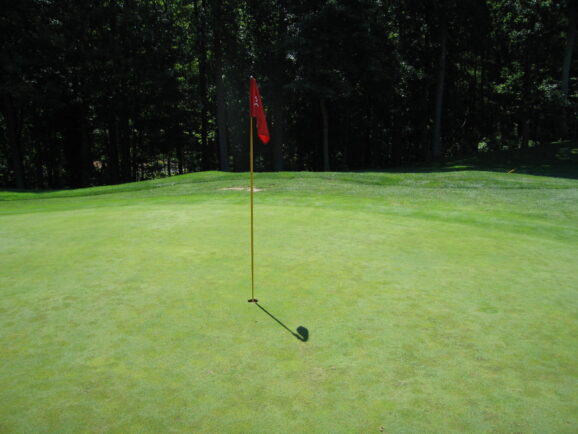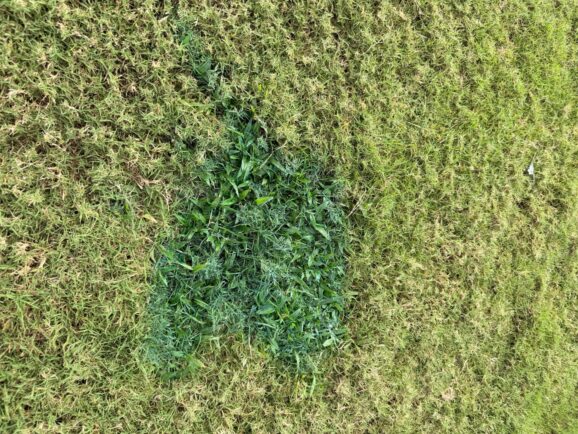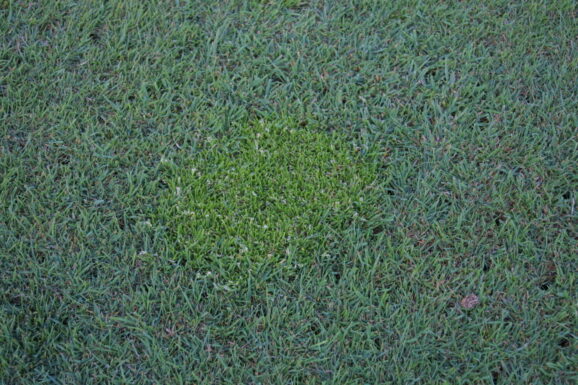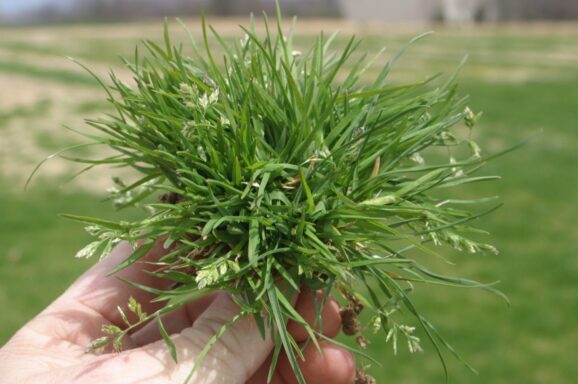
Poa annua, or annual bluegrass, is the most persistent weed on managed golf turf because it thrives in exactly the conditions that produce tournament-grade playing surfaces. A single infested putting green can carry a seed bank of roughly 19,500 viable seeds per square foot1, and those seeds stay viable in the soil for years. This guide covers how to identify annual bluegrass in the field, the biology that makes it so hard to remove, the damage it does to playing surfaces, and the integrated program that keeps it in check.
Key takeaways
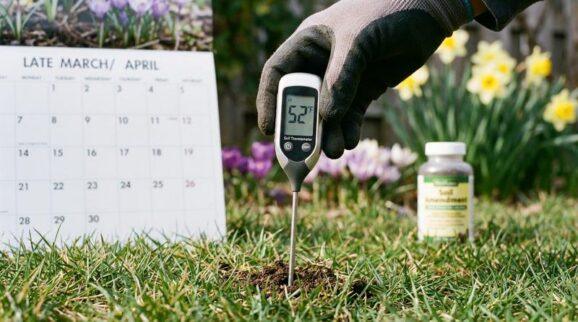
- Poa annua is a winter annual that germinates in fall as soil temperatures drop below 70°F, survives winter, and pushes seedheads in spring2.
- A managed putting green can hold a seed bank of roughly 19,500 viable seeds per square foot3, which refills faster than any single control pass can deplete it.
- On creeping bentgrass and Kentucky bluegrass surfaces, Poa annua lowers quality through a lighter green color, prolific seedheads, and a shallow root system that raises water and fungicide demand4.
- Identification rests on three field cues: a boat-shaped leaf tip, a tall membranous ligule, and whitish seedheads produced even at mowing heights below 0.125 inch.
- No single tool removes Poa annua; control combines cultural pressure, rotated herbicide chemistry, and precise application.
What is Poa annua (annual bluegrass)?
Poa annua (annual bluegrass) is a cool-season grassy weed found on virtually every golf course in the cool and transition zones, and on the overseeded surfaces of warm-season courses. The name covers two overlapping forms that a superintendent has to manage differently.
- Annual form: behaves like a classic weed, flushing in cool weather and dying back, and refilling the seed bank with each cycle.
- Perennial biotype: establishes a near-permanent stand on greens and collars, where it can quietly become the dominant species before anyone decides to act.
- Genetic flexibility: annual bluegrass is allotetraploid, carrying the combined genetics of two parent species, which lets it shift growth habit, flowering, and stress response to match the management it receives.
That genetic library is the root cause of nearly every control problem that follows. The same plasticity that lets Poa annua switch between annual and perennial habits also lets it adapt to mowing, irrigation, and chemistry faster than a fixed program can counter.
How to identify Poa annua on turf
Three visible cues separate Poa annua from the desirable grasses around it, and all three can be checked in the field without a lab.
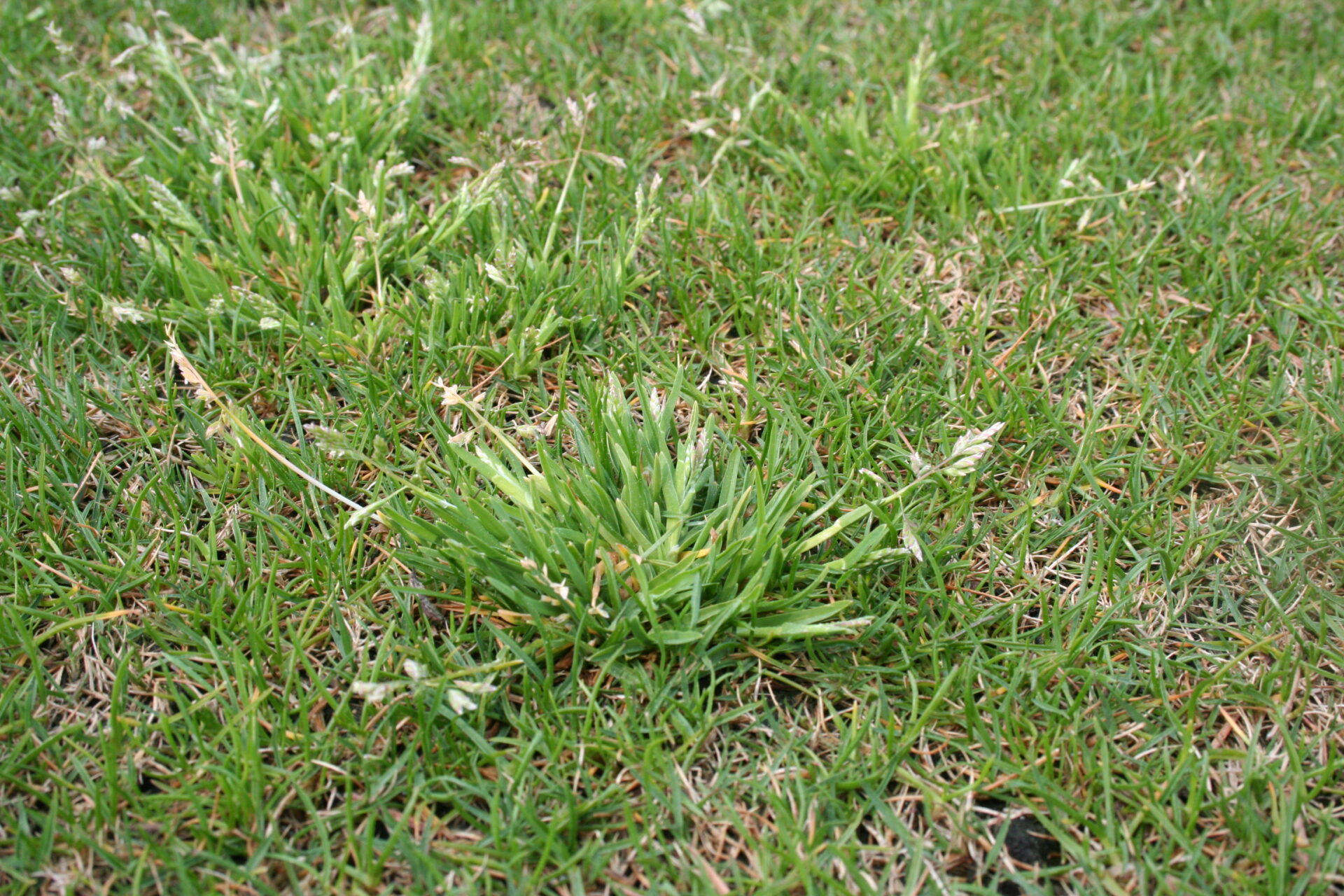
- Leaf tip and texture: the leaf blade is soft, often slightly crinkled, with a distinctive boat-shaped (keeled) tip. Held against bentgrass, the blade looks wider and a lighter, more yellow-green.
- Ligule: at the base of the leaf blade sits a tall, membranous ligule, noticeably longer than the short ligule of creeping bentgrass. This single structure is the most reliable separator on greens.
- Seedheads: Poa annua produces small, whitish, triangular seedheads even when mown below 0.125 inch. On a green, a flush of seedheads reading as a grey-white cast across the surface is the clearest signal of an established stand.
- Growth habit: it forms a low, bunch-type to slightly spreading patch, often a brighter green than the surrounding canopy in cool weather, then yellowing under heat or drought stress.
A quick field check beats a guess. Pull a single plant, look for the boat-shaped tip and the tall membranous ligule together, and confirm with the seedhead flush. Color alone is misleading, because nitrogen and moisture swings push bentgrass toward the same light green that flags annual bluegrass.
The biology that makes Poa annua so persistent
Annual bluegrass persists because its life cycle and its seed bank both outrun a fixed control calendar. Germination in cool-season turf is keyed to soil temperatures falling below 70°F in the fall5, with a smaller spring flush as soils warm. The plant overwinters, then produces seedheads through spring and into early summer.
The seed numbers are the heart of the problem. Research on a closely mown putting green measured a seed bank of roughly 19,500 viable seeds per square foot6, and that seed remains viable in the soil bank for several seasons. A clean-looking surface can still carry years of germination potential underneath it.
Two biological traits compound the seed pressure:
- Seed production at putting-green height: the plant sets viable seed even when mown below 0.125 inch, so mowing does not stop reproduction the way it does for taller weeds.
- Phenotypic plasticity: the same allotetraploid genetics let annual bluegrass shift from an annual to a perennial habit under intensive mowing and irrigation, then revert within a season once pressure eases.
The practical consequence is that timing matters more than intensity. A control program aligned to the fall germination window does far more than a heavier program applied at the wrong time, because the seed bank refills on its own schedule, not the superintendent's.
Why Poa annua is a problem on golf courses
Poa annua degrades playing surfaces in ways that go well beyond appearance. It is documented as a major weed of greens built on creeping bentgrass and Kentucky bluegrass, where it reduces quality through a lighter green color, unsightly seedheads, and a shallow root system, and it carries poor disease, drought, and wear tolerance that forces up water, fungicide, and management inputs7.
- Playability and aesthetics: seedhead flushes disrupt ball roll and leave a mottled, off-color surface that reads poorly under tournament scrutiny and on broadcast.
- Agronomic fragility: the shallow root system collapses under heat, drought, and traffic, so a Poa-dominated green is one stress event away from thinning or going out entirely.
- Input load: the same fragility means more frequent fungicide cover for diseases such as anthracnose, more hand-watering, and tighter management windows through summer.
The strategic risk is concentration. Because the perennial biotype can take over a green gradually, many courses do not act until annual bluegrass is the dominant turf, at which point removing it means losing the playing surface for a renovation. Early, sustained pressure is far cheaper than late eradication.
Where Poa annua thrives: the conditions that invite it
Annual bluegrass colonizes the openings that intensive management creates. It favors moist, compacted, low-mown, and disturbed ground, which describes the highest-value surfaces on the course.
- Compaction and traffic: cart paths, walk-on and walk-off points, and high-traffic approaches compact the soil and thin the stand, opening space the weed exploits.
- Excess surface moisture: frequent light irrigation and poorly draining low spots keep the surface wet, favoring germination over deep-rooted desirable turf.
- Low mowing and thin canopy: closely mown greens and any bare or weakened patch give annual bluegrass the light and room a dense canopy would deny it.
Read the infestation as a diagnosis. A spreading Poa stand usually points to a maintenance condition (compaction, overwatering, or a thin canopy) that favors the weed, so the durable fix addresses the condition alongside the plant.
How to control Poa annua: an integrated program
No single lever controls annual bluegrass on its own; the programs that hold combine cultural control methods, rotated chemistry, and precise application worked together across the season.
Cultural levers that shrink the niche
Cultural practices remove the conditions Poa annua needs and tilt competition back toward the desirable stand.
- Raise and sharpen mowing within agronomic limits during peak emergence to favor a denser cool-season canopy.
- Switch to deep, infrequent irrigation to dry the surface between cycles and disadvantage shallow-rooted seedlings.
- Relieve compaction through aerification and traffic management on the worst approaches and collars.
- Apply plant growth regulators such as paclobutrazol and trinexapac-ethyl, which suppress annual bluegrass more than surrounding bentgrass and reduce seedhead expression.
These levers run continuously, not as a one-time fix. They will not eradicate an established stand on their own, but without them, chemistry alone burns out fast.
Chemical control: pre- and post-emergence
Herbicide programs work on two fronts. A fall pre-emergence herbicide program sets a soil barrier timed to the germination window, while post-emergence chemistry targets plants that escape. Superintendents building the soil-residual side of the program can follow the dedicated pre-emergence weed control guide to map each option to the fall germination window before the first application.
- Pre-emergence anchors include prodiamine, pendimethalin, dithiopyr, and oxadiazon, applied before the fall flush.
- Post-emergence options span several modes of action, with methiozolin offering selective, root-uptake control on greens and other chemistry covering fairways and roughs.
- Timing trumps rate: align the main fall application to the soil-temperature curve rather than the calendar, because a barrier set too early decays before the seedlings arrive.
Match every product to the turf species first. Cool-season and warm-season grasses tolerate different chemistry, and US herbicide labels vary by state, so a tool that is safe on one surface in one state may be off-label on another.
Resistance management
Annual bluegrass evolves herbicide resistance faster than almost any turf weed. It ranks among the most herbicide-resistant weed species in the world, with documented resistance to multiple modes of action across US turf8. A mode of action is the specific biological process a herbicide attacks, and once a population survives one, every product built on it fails together.
The defense is rotation. Never apply two consecutive treatments from the same mode of action on the same surface, count distinct modes (not brand names) across a multi-year window, and tank-mix two modes where labels allow. Confirm suspected resistance through a university Cooperative Extension lab before rewriting the program, since most field escapes are application errors rather than true resistance.
Precision spot spraying
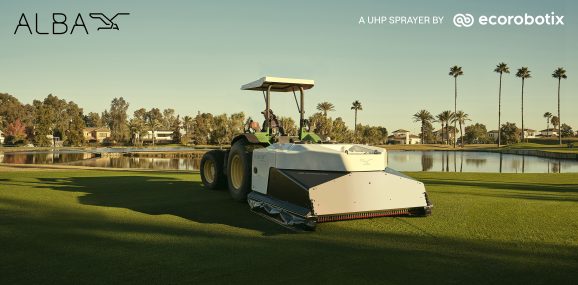
Where annual bluegrass shows up in mapped patches rather than a uniform stand, treating those patches plant by plant protects the surrounding desirable turf and preserves the rotation value of each herbicide. The ALBA ultra-high-precision sprayer detects Poa annua from 4 mm, delivers a 3 cm² spray spot, and applies registered chemistry only to the plants it identifies. In turf trials, Ecorobotix reports 70 to 90% herbicide reduction with this approach while holding playing-surface quality.
For courses scoping the economics, an on-course Turf Care audit from Ecorobotix reports on the state of the turf, the effectiveness of the current program, and the input savings precision spraying can deliver, with the technology proven across 500+ agricultural clients in 20+ countries and now adapted for turf. The same precision logic feeds directly into broader efforts to reduce turf management costs without sacrificing quality, and it projects return on investment within three years through input and labor savings.
Building a Poa annua program that holds
Poa annua control is a seed-bank problem before it is a herbicide problem. The plant germinates below 70°F in fall, builds a seed bank of roughly 19,500 viable seeds per square foot9, and ranks among the world's most resistant weeds10, so any program built on a single chemistry or a single pass will lose ground.
The durable answer layers cultural control method that shrinks the niche, rotated pre- and post-emergence chemistry timed to soil temperature, and precision spot spraying that contains the herbicide load to the patches that carry the weed. Start by reading each green's infestation as a diagnosis of its management, then decide which preemergence chemistry anchors the fall program and exactly when to apply it. As resistance pressure keeps building across turf weeds, the next step is to track each green's response season over season and diversify the modes of action in play before any single chemistry stops working.
FAQ
Is Poa annua a grass or a weed?
Both. Poa annua (annual bluegrass) is a true grass species, but on managed golf turf it behaves as a weed because it disrupts surface uniformity, sets prolific seedheads, and tolerates stress poorly. On a putting green built for bentgrass, any species that breaks that uniformity is a weed regardless of its botany.
When does Poa annua germinate?
Mostly in the fall, as soil temperatures fall below 70°F, with a smaller flush in spring as soils warm [2]. This is why the main pre-emergence application is timed to the fall soil-temperature curve rather than a fixed calendar date.
Why is Poa annua so hard to get rid of?
Three reasons stack up: a dense seed bank of roughly 19,500 viable seeds per square foot that stays viable for years [1], the ability to set seed even at putting-green mowing heights, and fast evolution of herbicide resistance across multiple modes of action [4]. Removing it takes sustained pressure on all three fronts, not a single treatment.
Can you control Poa annua without losing the green?
Yes, when the stand is caught early and managed rather than eradicated. Cultural levers, rotated chemistry, and precision spot spraying hold an infestation in check. Once annual bluegrass becomes the dominant turf, removal usually means a renovation, which is why early action is far cheaper than late.
Does precision spot spraying help with Poa annua?
Yes, when patches are already mapped. Treating mapped patches plant by plant rather than blanket-spraying a surface limits the exposure of surrounding desirable turf and preserves each herbicide's rotation value. The ALBA sprayer applies registered chemistry only to detected weeds, and Ecorobotix reports 70 to 90% herbicide reduction in turf trials.
- Lush, W. M. (1988). "Biology of Poa annua in a Temperate Zone Golf Putting Green (Agrostis stolonifera/Poa annua). II. The Seed Bank." Journal of Applied Ecology 25(3):989-997. https://www.jstor.org/stable/2403760 ↩︎
- Advanced Turf Solutions (2019). "Annual Bluegrass Seedhead Control." https://www.advancedturf.com/resources/annual-bluegrass-seedhead-control ↩︎
- Lush, W. M. (1988). "Biology of Poa annua in a Temperate Zone Golf Putting Green (Agrostis stolonifera/Poa annua). II. The Seed Bank." Journal of Applied Ecology 25(3):989-997. https://www.jstor.org/stable/2403760 ↩︎
- Global Invasive Species Database (consulted 2026). "Species profile: Poa annua". IUCN Invasive Species Specialist Group. https://www.iucngisd.org/gisd/speciesname/Poa+annua ↩︎
- Advanced Turf Solutions (2019). "Annual Bluegrass Seedhead Control." https://www.advancedturf.com/resources/annual-bluegrass-seedhead-control ↩︎
- Lush, W. M. (1988). "Biology of Poa annua in a Temperate Zone Golf Putting Green (Agrostis stolonifera/Poa annua). II. The Seed Bank." Journal of Applied Ecology 25(3):989-997. https://www.jstor.org/stable/2403760 ↩︎
- Global Invasive Species Database (consulted 2026). "Species profile: Poa annua". IUCN Invasive Species Specialist Group. https://www.iucngisd.org/gisd/speciesname/Poa+annua ↩︎
- Heap, I. (consulted 2026). "International Survey of Herbicide Resistant Weeds". Weed Science Society of America. https://www.weedscience.org/ ↩︎
- Lush, W. M. (1988). "Biology of Poa annua in a Temperate Zone Golf Putting Green (Agrostis stolonifera/Poa annua). II. The Seed Bank." Journal of Applied Ecology 25(3):989-997. https://www.jstor.org/stable/2403760 ↩︎
- Heap, I. (consulted 2026). "International Survey of Herbicide Resistant Weeds". Weed Science Society of America. https://www.weedscience.org/ ↩︎