A post-emergent herbicide controls weeds that are already growing, which makes it the second line of defense behind a fall pre-emergent program on golf turf. When seedlings escape the soil barrier, or when a weed germinates outside the residual window, post-emergence chemistry is what removes it without tearing up the playing surface.
That second line has a narrow window: a post-emergent works most reliably on a young, actively growing weed and often fails on a mature or stressed plant1. This guide covers the types, matching product to weed and turf, timing, and why applications fail.
Key takeaways
- A post-emergent herbicide treats weeds after they emerge, while a pre-emergent sets a soil barrier before germination; most turf programs need both.
- The main distinctions are selective vs non-selective, contact vs systemic, and liquid vs granular, and each pairing changes what you can safely spray on a fairway or green.
- Control depends on weed growth stage: young, actively growing weeds take up herbicide far better than mature or stressed plants.
- Turf species tolerance decides the product list, and US herbicide labels vary by state, so a tool that is safe on one surface may be off-label on another.
- Repeated reliance on one mode of action drives resistance, so rotation and precise placement protect every product's working life.
What is a post-emergent herbicide?
A post-emergent herbicide is a product applied directly to weeds that have already broken the soil surface and are visible in the stand. It enters the plant through the foliage, stems, or roots and disrupts a specific biological process the weed depends on to grow.
This is the opposite of a pre-emergent, which forms a residual barrier in the soil and stops seedlings as they germinate. A pre-emergent does nothing to a weed that is already established, and a post-emergent does nothing to seeds still in the soil bank. The two tools cover different points in the weed life cycle, which is why a complete turf program runs them in sequence rather than choosing between them.
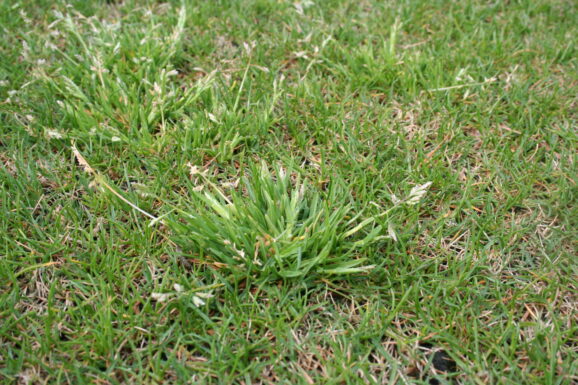
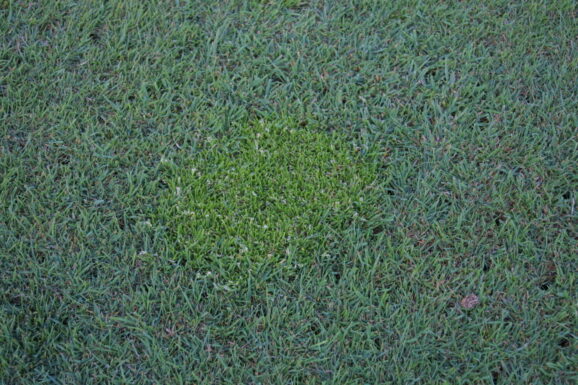
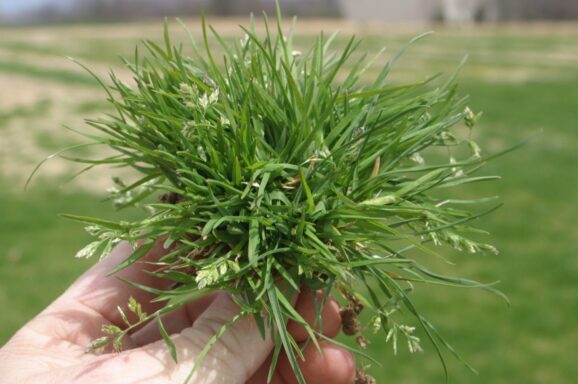
On golf turf, post-emergence chemistry handles the escapes: the annual bluegrass that slipped past a thin spot in the barrier, the summer broadleaf that germinated after the residual decayed, or the perennial grass weed that no pre-emergent controls at all.
Post-emergent vs pre-emergent on turf
The two herbicide classes answer different questions, and confusing them is the most common reason a program underperforms. The table below frames the split as a superintendent uses it.
| Factor | Pre-emergent | Post-emergent |
| Target | Germinating seedlings | Emerged, visible weeds |
| Timing | Before the germination flush | After weeds appear, while young |
| Mode | Soil residual barrier | Foliar or systemic uptake |
| Misses | Weeds already established | Seeds still in the soil bank |
| Role on course | Primary annual weed defense | Cleanup of escapes and perennials |
The practical reading is that a pre-emergent does the heavy lifting against predictable annual flushes, while a post-emergent is the corrective tool for everything that gets through. Building the soil-residual side of the program is a separate decision, covered in this pre-emergence weed control guide.
The main types of post-emergent herbicides
Post-emergent products are sorted along three axes, and every label combines one choice from each. Reading those three traits tells you whether a product belongs on a green, a fairway, or only a non-play area.
Selective vs non-selective
A selective herbicide controls target weeds while leaving the desirable turf species unharmed, which is what allows in-bounds treatment of a broadleaf or grassy weed inside a stand of bentgrass or bermudagrass. A non-selective herbicide injures or kills most green plant tissue it contacts, so its use is limited to spot treatment, renovation, and hardscape edges where no desirable turf is at risk.
Selectivity is never absolute. It depends on rate, turf species, temperature, and growth stage, so a selective product applied off-label or under heat stress can still thin or discolor the very turf it is meant to protect.
Contact vs systemic
A contact herbicide kills only the tissue it physically touches, producing fast visible burn-down but no movement into roots or rhizomes. It works well on small annual weeds, yet perennials regrow from untreated underground parts. A systemic herbicide is taken up by the foliage and translocated through the plant to the growing points, which gives slower but more complete control of established and perennial weeds.
The trade is speed against thoroughness. Contact products satisfy the urge to see a result by tomorrow; systemic products do the real work on the weeds that matter most on a golf course.
Liquid vs granular
A liquid formulation is sprayed for even foliar coverage and is the standard for most selective post-emergence work on play surfaces, because uptake depends on the herbicide reaching the leaf. A granular formulation is spread dry and is easier to apply without a sprayer, but it relies on the product sticking to wet foliage, so coverage is less consistent for many post-emergent actives.
For most superintendent applications, liquid wins on coverage and control precision. Granular post-emergents have a narrower role, usually weed-and-feed products where the herbicide rides along with fertilizer.
How post-emergent herbicides work
Every post-emergent herbicide attacks a specific biological process inside the weed, and that target is called its mode of action. One product might block a plant enzyme essential to making amino acids, another might disrupt photosynthesis, and another might mimic a growth hormone until the plant grows itself to death.
Two facts follow from this for turf managers. First, the herbicide has to reach and enter the living plant, so coverage, leaf surface, and plant health at the time of spraying all govern whether it works. Second, weeds that survive a mode of action can pass that survival trait to the next generation, which is the seed of resistance.
Effective uptake also depends on the weed being awake. A plant under drought, heat, or mowing stress slows its metabolism and moves less herbicide to the target site, which is why a stressed weed often shrugs off a rate that would have controlled it a week earlier.
How to choose the right post-emergent for turf weeds
Product selection on a golf course follows a short decision sequence. Skipping a step is how the wrong herbicide ends up in the tank.
- Identify the weed first. Grassy weeds, sedges, and broadleaves respond to different chemistry, and a misidentified weed is a wasted application. Confirm the species before choosing a product.
- Check turf tolerance. Cool-season and warm-season grasses tolerate different actives, and tolerance shifts with the season. The desirable species sets the shortlist before anything else.
- Decide speed versus completeness. A visible escape before an event may justify a faster contact product, while a perennial infestation needs a systemic that reaches the roots.
- Read the label for the state. US herbicide labels vary by state and by site, so a product cleared for fairway use in one state may be off-label on the same surface in another. The label is the law.
Match the product to the turf species first, then to the weed. Reversing that order is how superintendents injure the stand they are trying to protect.
Application: timing, conditions, and coverage
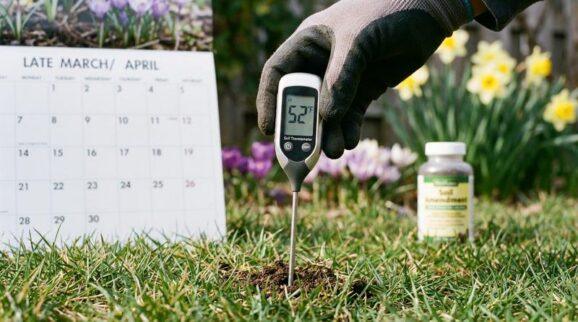
Timing decides most of the outcome. Post-emergent herbicides work best on young weeds that are actively growing, before they set seed and before summer stress slows their uptake2. A weed treated at the two-leaf stage is a different target from the same weed a month later.
- Treat early and actively growing. Small weeds in mild, moist conditions take up and translocate herbicide efficiently. Mature, flowering, or drought-stressed weeds resist the same rate.
- Respect the weather window. Heat, drought, and the threat of rain before the product dries all cut performance and raise the risk of turf injury. Spray into the conditions the label specifies.
- Cover the leaf. For foliar products, control tracks coverage. Calibrate the sprayer, hold the labeled carrier volume, and keep nozzles and pressure within the range the product needs.
- Allow for the rotation. Plan the next application around mode-of-action rotation, not just the calendar, so no single chemistry carries consecutive treatments on the same surface.
A second application is often part of the plan rather than a sign of failure, especially for perennials and for flushes that emerge across a long window. Build the follow-up into the program from the start.
Why post-emergent applications fail
When a treated weed survives, the cause is usually one of a short list, and resistance is the last suspect rather than the first.
- Wrong timing. The weed was too mature, already seeding, or under stress when treated, so it never took up a lethal dose.
- Poor coverage. A miscalibrated sprayer, too little carrier volume, or worn nozzles left part of the canopy untreated.
- Wrong product for the weed or turf. A contact product was used on a perennial, or a selective product was pushed past the rate its turf tolerates.
- Environmental interference. Rain washed the product off before uptake, or heat and drought shut down translocation.
- True resistance. The population has survived this mode of action before, and only a different chemistry will control it.
Diagnose the cause before re-spraying. Repeating a failed application with the same product at a higher rate compounds turf injury and accelerates resistance without fixing the underlying problem.
Resistance management
Weeds evolve herbicide resistance fastest where the same chemistry is used repeatedly, and turf surfaces are prime ground because they are treated intensively year after year. The international resistance record maintained by the Weed Science Society of America (WSSA) documents weed populations that survive multiple modes of action, including key turf weeds3.
The defense is rotation by mode of action, not by brand name. Track the Herbicide Resistance Action Committee (HRAC) group of every product, never run two consecutive treatments from the same group on the same surface, and tank-mix two effective modes where the label allows. Confirm suspected resistance through a university Cooperative Extension diagnostic before rewriting the program, because most field escapes trace back to timing or coverage rather than genetics4.
Precision spot spraying
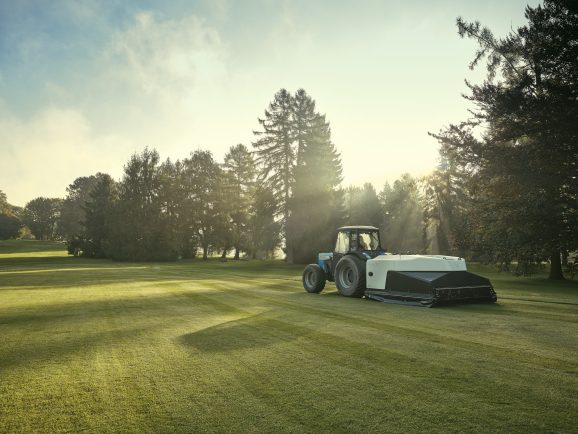
Most post-emergent weeds appear in patches and along stress lines rather than uniformly across a surface, which means a blanket spray treats a large area of clean turf to reach a small fraction of weeds. Treating only the weeds protects the surrounding stand and stretches the rotation value of each mode of action.
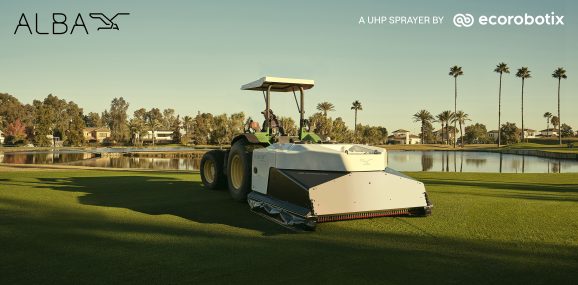
The ALBA ultra-high-precision sprayer detects weeds from 4 mm, delivers a 3 cm² spray spot, and applies registered post-emergence chemistry only to the plants it identifies. In turf trials, Ecorobotix reports 70 to 90% herbicide reduction with this approach while holding playing-surface quality, and the platform is proven across 500+ agricultural clients in 20+ countries and now adapted for turf.
For courses scoping the economics, an on-course Turf Care audit from Ecorobotix reports on the state of the turf, the effectiveness of the current program, and the input savings precision spraying can deliver. The same precision logic supports broader efforts to reduce turf management costs without compromising quality, and it projects return on investment within three years through input and labor savings.
Building a post-emergent program that holds
A post-emergent herbicide is a corrective tool, not a standalone plan. It cleans up the weeds that escape a fall pre-emergent barrier and the perennials that no residual controls, and it does that best when applied to young, actively growing plants at full coverage.
The durable program identifies the weed and the turf species first, picks the product type that fits both, times the application to the weed rather than the calendar, rotates modes of action to slow resistance, and contains the herbicide load to the patches that carry the weed. Start by auditing which weeds are actually escaping the current program, then decide which post-emergence chemistry each one requires and exactly when to apply it.
As resistance pressure builds and label options narrow season over season, the courses that stay ahead will be the ones that map their weed escapes now and rotate modes of action before any single chemistry stops working.
FAQ
What is the difference between pre-emergent and post-emergent herbicides?
A pre-emergent forms a residual barrier in the soil and stops weed seeds as they germinate, so it is applied before the germination flush. A post-emergent treats weeds that are already visible and growing. They cover different points in the weed life cycle, which is why most golf turf programs use both rather than choosing one.
When should you apply a post-emergent herbicide on turf?
Apply it when target weeds are young and actively growing, in mild and moist conditions, before they set seed and before summer stress slows uptake. A small weed treated early takes up a lethal dose far more reliably than a mature, flowering, or drought-stressed plant treated weeks later.
What is the difference between selective and non-selective herbicides?
A selective herbicide controls target weeds while leaving the desirable turf species unharmed, so it can be sprayed inside a stand. A non-selective herbicide injures most green tissue it contacts, so its use is limited to spot treatment, renovation, and non-play areas where no desirable turf is at risk.
Why did my post-emergent application not work?
The usual causes, in order, are wrong timing, poor spray coverage, the wrong product for the weed or turf, and weather interference such as rain or heat. True herbicide resistance is the last suspect, not the first. Diagnose the cause before re-spraying, because repeating a failed pass at a higher rate accelerates resistance and turf injury.
Does precision spot spraying work for post-emergent control?
Yes, when weeds appear in patches rather than uniformly. Treating only the detected weeds limits the exposure of surrounding turf and preserves each herbicide's rotation value. The ALBA sprayer applies registered chemistry only to identified plants, and Ecorobotix reports 70 to 90% herbicide reduction in turf trials.
Sources
- United States Golf Association (USGA) Green Section Record (consulted 2026). "Weed Control on Golf Course Turf". https://gsr.usga.org/ ↩︎
- United States Golf Association (USGA) Green Section Record (consulted 2026). "Weed Control on Golf Course Turf". https://gsr.usga.org/ ↩︎
- Heap, I. (consulted 2026). "International Survey of Herbicide Resistant Weeds". Weed Science Society of America. https://www.weedscience.org/ ↩︎
- Penn State Extension (consulted 2026). "Turfgrass Weed Management". The Pennsylvania State University. https://extension.psu.edu/ ↩︎