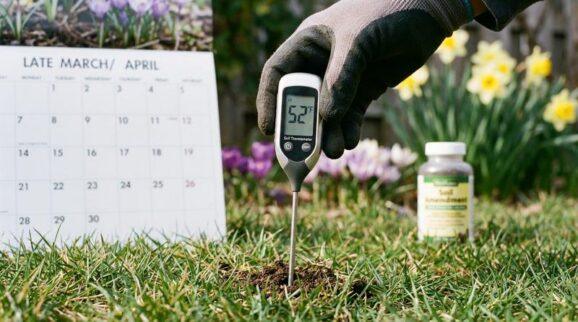
A poa annua pre emergent only works when the herbicide barrier is in place before fall germination starts, which on most US lawn or turf means applying 2 to 3 weeks before 4-inch (10 cm) soil temperatures drop below 70 °F (21 °C)1.
In cool-season regions, that soil-temperature rule places the application in mid-August to early September2.
This guide covers the soil temperature trigger, the herbicide modes of action (MOA) labeled for annual bluegrass, herbicide selection by turfgrass species, application mechanics, split-rate logic, the overseeding conflict, and how ultra-high precision delivery refines the same chemistry on elite golf courses.
Key takeaways
- A 4-inch (10 cm) soil temperature trending toward 70 °F (21 °C) is the trigger for the pre-emergence application, not the calendar date3.
- Annual bluegrass ranks third among the most herbicide-resistant weed species worldwide4, with confirmed resistance to 8 of 12 modes of action registered for control on US lawn and turf5.
- Several active ingredients carry routine US labels for the poa annua pre emergent program, and the ones you meet most often are prodiamine, dithiopyr, indaziflam and oxadiazon, plus simazine on dormant Bermuda6. The list is wider than these, so build the program from the label in front of you rather than from a fixed shortlist.
- Split prodiamine applications extend the residual barrier across the full fall risk window.
- In Ecorobotix turf trials, ultra-high precision delivery on professional turf cuts total herbicide rate by 70 to 90 percent by treating only the annual bluegrass plants the sprayer identifies7.
The soil temperature window for poa annua pre emergent
Apply when the 4-inch (10 cm) soil temperature is 2 to 3 weeks ahead of the 70 °F (21 °C) threshold, which places the herbicide in the ground before annual bluegrass germinates8. The regional windows below follow the published consensus timing9; calendar dates are only a starting reference.
| Climate zone | Typical apply window |
| Upper transition (cool-season fairway) | mid-August to early September |
| Southeast Bermuda fairway | September to early October |
| Deep South (FL, southern TX) | October |
The 4-inch (10 cm) depth soil temperature matters because that is where the annual bluegrass seed bank sits and where germination is triggered. Surface readings drop faster than the 4-inch (10 cm) number, so air-temperature heuristics misfire on autumn timing. The Network for Environment and Weather Applications (NEWA), Syngenta Green Cast, and the USA National Phenology Network (USA-NPN) soil temperature trackers give a sharper signal than weather forecasts.
A spring pre emergent can catch a small secondary flush where it occurs, which is less common for poa annua than for crabgrass10, but the early-September timing is the decisive one for annual bluegrass. When temperature readings begin to cross the 70 °F (21 °C) trigger, apply on the early side; a few weeks of residual lost to initial timing is a smaller cost than missing the pre-emergent application window.
Why poa annua needs a pre emergent: the fall germination pulse
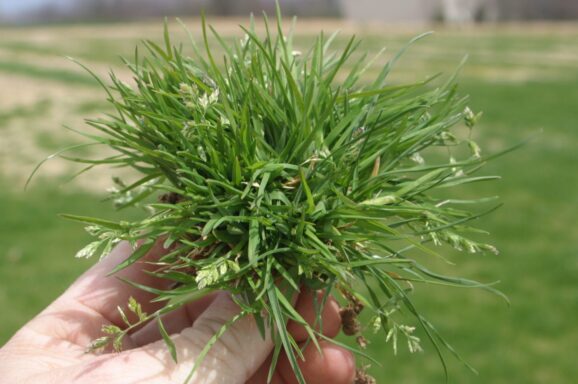
Annual bluegrass is a winter annual on most US golf course surfaces, with the cohort lined up in a 2 to 4 week germination window every fall. The species is allotetraploid (Poa supina × Poa infirma), and that double genetic library underwrites its phenotypic plasticity. It shifts from annual to perennial habit under intensive mowing, then reverts within a single growing year.
Three biological levers make the pre emergent program the highest-value intervention available.
- Prolific seed production at putting-green height refills the seed bank faster than any single herbicide application can deplete the surviving cohort.
- Synchronized fall emergence lines up most of the year's seedlings inside the same short window the barrier has to cover.
- Seedling survival under defoliation and traffic: Poa annua seedlings start to survive repeated mowing and traffic after the first true leaf grows, which makes them harder to control with post emergent herbicide applications.
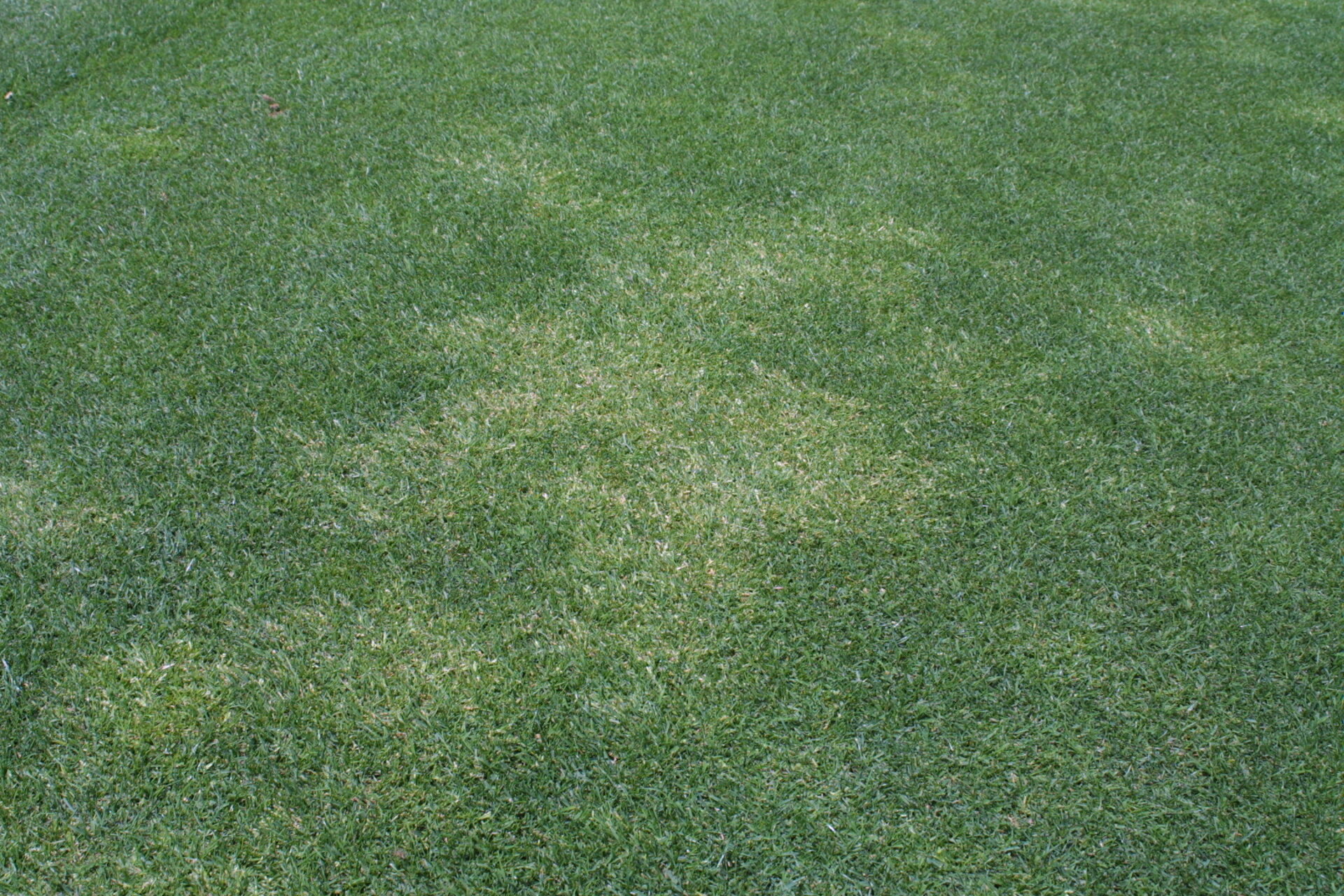
Each missed cycle feeds a multi-year seed bank. Acting before poa annua germination occurs is cheaper and more efficient than chasing poa annua after tillering.
Pre emergent herbicides for poa annua: modes of action and residual
Four modes of action are labeled for annual bluegrass control on US lawns and golf courses, grouped by the Herbicide Resistance Action Committee (HRAC) as Groups 3, 14, 29, and 5 (Bermuda or zoysia only)11. Group 3 inhibits microtubule formation, Group 14 inhibits protoporphyrinogen oxidase (PPO), Group 29 inhibits cellulose biosynthesis, and Group 5 inhibits photosystem II (PSII). HRAC group numbering is now aligned with the Weed Science Society of America (WSSA) classification, so the two systems classify the herbicides the same way.
| HRAC | Active ingredient | Common trade name | Residual |
| 3 | prodiamine | Barricade, Resolute | 4 to 6 months |
| 3 | dithiopyr | Dimension, generics | 3 to 4 months |
| 3 | pendimethalin | Pendulum, generics | 3 to 4 months |
| 14 | oxadiazon | Ronstar, generics | 4 to 5 months |
| 29 | indaziflam | Specticle (patented) | 6 to 8 months |
| 5 | simazine, atrazine | Princep, AAtrex | 2 to 3 months (dormant Bermuda only) |
Two practical consequences follow. First, prodiamine, dithiopyr, and pendimethalin all belong to HRAC Group 3, so rotating among them changes the active ingredient without changing the herbicide mode of action. True rotation moves among Group 3, Group 14, Group 29, and Group 5 across years. Second, no new MOA groups are expected in turfgrass any time soon12, which makes preserving the existing options through rotation the single most valuable control practice available.
A safe baseline program rotates Group 3 (prodiamine) one year, Group 29 (indaziflam) the next where the label fits, with Group 14 (oxadiazon) for Bermuda. Bentgrass greens narrow the chemistry sharply; spot management and cultural work do more of the control there.
Resistance changes the rotation math. The United States Golf Association (USGA) Green Section Record reports that annual bluegrass populations resistant to indaziflam were first documented on southeastern US golf course fairways after poor fall control in 2015, then confirmed in Pest Management Science in 20201314. The same resistant populations broke seven additional herbicides at once. A program built on a single mode of action is structurally exposed regardless of how disciplined the application timing is, which is why mode-of-action rotation has displaced trade-name rotation in practice.
Choosing the right herbicide by lawn or turf type
Herbicide fit is driven first by turfgrass species tolerance, then by residual length, and only third by price. Labels differ and damage to the desirable lawn or fairway typically costs more than the herbicide.
- Cool-season fairway, rough, or lawn (creeping bentgrass, fine fescue, Kentucky bluegrass, perennial ryegrass): prodiamine is the workhorse. Dithiopyr fits where 1-leaf post emergent rescue matters.
- Warm-season fairway or lawn (Bermuda, zoysia, paspalum): indaziflam is the pre-emergent most used against annual bluegrass on bermudagrass, with prodiamine and oxadiazon covering much of the rest. Simazine on dormant Bermuda adds early post emergent activity against winter weed pressure.
- Residential cool-season lawn (Kentucky bluegrass, tall fescue, ryegrass): prodiamine stays the most flexible choice; granular formulations on a fertilizer carrier simplify spreader calibration. Avoid pendimethalin where overseeding is planned the same year.
- Residential warm-season lawn (Bermuda, zoysia, St. Augustine, centipede): prodiamine, dithiopyr, or oxadiazon all fit. Atrazine stays common across the Southeast on dormant Bermuda and centipede lawn use.
Sand-based putting green construction restricts most labels, and bentgrass greens have very narrow chemical options. In these types of greens managing annual bluegrass requires a tightened cultural program plus surgical post emergent application where labels allow.
Whatever the residual length, most cool-season programs apply pre-emergent twice a year, one application in the fall and one in the spring. Residual length changes how much each one has to cover, not how many go down.
Cool-season programs and warm-season programs also diverge on residual length. A 4 to 6 month prodiamine residual covers the entire fall risk window on a fescue or Kentucky bluegrass lawn or fairway, while a 6 to 8 month indaziflam residual reaches further toward the spring crabgrass window on Bermuda. Sequence matters: a long-residual herbicide applied too early in autumn shortens spring coverage; the same herbicide applied at the soil-temperature trigger covers both windows.
How to apply pre emergent correctly: rate, coverage, water-in
The herbicide works as a thin soil barrier across the full treated area, so uneven coverage means breakthrough strips a few weeks later. Application discipline decides the outcome.
- Calibrate the spreader or boom sprayer. A calibration error across a fairway is a common cause of program failure.
- Apply at the labeled rate. Above-label use raises injury risk on the desirable grass; below-label use selects for resistant biotypes faster than any other application error.
- Water in herbicide within the label window, typically 0.5 inch (1.3 cm) of irrigation or rainfall in 24 to 48 hours. Most active ingredients degrade if left on the surface.
- Avoid soil disturbance for 4 to 6 weeks. Aerification, verticutting, and topdressing break the barrier; schedule those operations either before the application or after the residual is spent.
- Document the treatment area and the rate. Resistance management is a multi-year discipline, and the rotation log makes the HRAC plan actually rotate.
The most common application failure is timing rather than mechanics: a perfect job after the first germination flush still misses the cohort that matters. Treat the first reliable 70 °F (21 °C) crossing as the deadline for the fall program. On high-pressure turf, the practical margin for error against an autumn application is narrow, so monitor 4-inch (10 cm) readings daily as they approach the 70 °F (21 °C) threshold.
Splitting the pre emergent, and how to recover a missed window
The two annual applications can go down as one fall application and one spring application, or the fall barrier can be split into two half-rate applications for longer residual. Two half-rate applications spaced 8 to 10 weeks apart extend the barrier deeper into the season than a single application. The annual rate stays within the label, and the barrier covers both the fall pulse and any late-fall or early-spring flush.
A standard fall split on cool-season lawn or fairways places two half-rate applications.
- First half-rate in mid-August to early September, 2 to 3 weeks before the 4-inch (10 cm) soil reading hits 70 °F (21 °C).
- Second half-rate in mid-October to early November, before dormancy.
Programs that follow fall-plus-spring instead of a fall split place one fall application and one spring application; the spring application covers a small March-April flush and is generally skipped on Bermuda or zoysia.
When the September control window is missed, the realistic options narrow. A spring application reduces a partial flush in cool-season turfgrass growing regions but does not recover the lost ground. Post emergent options for established annual bluegrass include amicarbazone, foramsulfuron, and ethofumesate, all label-dependent on species and weed stage. Pair post emergent applications with cultural moves: raise mowing height, withhold nitrogen during peak weed growth, and aggressively remove seed heads. Tighten the next autumn timing.
Pre emergent and overseeding: the conflict to plan around
Every effective pre emergent herbicide for poa annua control also blocks desirable cool-season seed germination for the same 12 to 16 weeks, which puts the autumn application directly in conflict with overseed work on the cool-season lawn or fairway, and on warm-season courses overseeded with perennial ryegrass for winter color. The conflict has three workable resolutions.
- Overseed first, apply pre emergent later. Seed in late summer, give 4 to 6 weeks of establishment, then apply. The trade-off is higher annual bluegrass emergence risk during establishment.
- Pre emergent first, overseed later. Apply on normal autumn timing, then wait until the residual is spent before overseeding the next late summer. Best fit for high-pressure sites.
- Skip pre emergent that year, manage post emergent in spring. Viable on one-cycle overseed programs (Bermuda fairway with ryegrass overseed). Plan for heavier cultural and post emergent work the following March-April.
Siduron is one label exception with selectivity for newly seeded cool-season lawn surfaces and limited annual bluegrass activity. It is not a full substitute. On every overseeded program, the herbicide label and the seed mix label decide what is possible.
Beyond chemistry: ultra-high precision pre emergence for elite turf
We believe a poa annua pre emergent program should be judged on how long its herbicides keep working, not on how much goes down. The modes of action still labeled for annual bluegrass are a finite resource, and treating plants rather than whole zones is how a course keeps them working.
On elite courses, the most effective refinement on top of mode-of-action rotation is precision delivery: applying registered herbicide only to the plants the sprayer identifies rather than across the whole surface. Ecorobotix ALBA, the ultra-high precision pre emergent and post emergent platform for professional courses, drives this approach with plant-by-plant detection and real-time kinematic (RTK) positioning. On a fall program, the same targeting also supports spot application on the annual bluegrass that escapes the barrier, which cuts seedhead presence and the seed returned to the surface for the following season.
The mechanics differ across two delivery models.
| Lever | Broadcast application | Precision delivery (ALBA) |
| Treated area | full fairway and rough | only the plants the sprayer identifies |
| Total field rate | full label rate across the full area | 70 to 90 percent reduction in turf trials15 |
| Detection threshold | none | annual bluegrass from 4 mm16 |
| Spray spot | nozzle-driven, no targeting | 3 cm-squared17 |
Precision delivery compounds mode-of-action rotation. A lower total field rate of the same active ingredient applies less selection pressure on the same HRAC group, which extends the useful life of prodiamine, indaziflam, and oxadiazon on the same fairway. The plant-by-plant technology is validated across more than 500 agricultural clients in over 20 countries18.
Superintendents and director-of-agronomy teams running an autumn program right now can request a Turf Care audit to map zone-level emergence pressure before next August.
Building a poa annua pre emergent program that lasts
A poa annua pre emergent program succeeds or fails on timing: the herbicide barrier has to be in the ground before the fall germination window opens, and no rescue recovers a cohort that has already tillered. The durable program rotates modes of action rather than trade names, matches the herbicide to the turfgrass species, and treats the first reliable 70 °F (21 °C) soil-temperature crossing as the deadline the calendar cannot override.
With no new modes of action expected for annual bluegrass, the courses that stay ahead will be the ones that lower selection pressure season over season, whether through disciplined rotation or by placing registered herbicide only where poa annua emerges. The practical next step is to log this fall's 4-inch (10 cm) soil readings and rotation history, so next August's application lands on evidence rather than on the calendar.
FAQ
Is there a pre emergent for poa annua?
Yes, and more than most shortlists suggest. Among the active ingredients commonly labeled for annual bluegrass control on US golf course surfaces: prodiamine, dithiopyr, indaziflam, and oxadiazon, spanning three modes of action (HRAC Groups 3, 29, and 14), with simazine and atrazine adding early post emergent activity on dormant Bermuda19. The right choice depends on the species and the residual length required.
What is the best month to apply pre emergent for poa annua?
Cool-season lawn or fairway targets mid-August to early September; warm-season grasses like Bermuda or zoysia target September to early October; deep-South sites often run into October20. The trigger is the 4-inch (10 cm) soil reading trending toward 70 °F (21 °C), with the application 2 to 3 weeks ahead of it21. Soil temperature beats the calendar in every program.
How do you treat poa annua post emergent if it is already visible?
Post emergent options include amicarbazone, foramsulfuron, ethofumesate, methiozolin, and a few selective combinations, all label-dependent on the desirable species and weed stage. Established annual bluegrass at tillering stage is far harder to control than 1-leaf seedlings, and rescue rarely matches a properly timed pre emergent. Pair chemistry with cultural control (mowing height, nitrogen restraint, seed-head removal) and tighten the next fall window.
How do you kill poa annua in the winter?
Winter post emergent options exist on dormant Bermuda (simazine, atrazine, selective grass-on-grass herbicides), but cool-season surfaces at dormancy offer very narrow windows. The realistic winter program is to monitor pressure, spot-treat where labels allow, and plan the next pre emergent application before the next fall trigger. Snow cover does not damage an established autumn barrier when the application was watered in correctly.
Can you apply pre emergent and overseed in the same year?
Most pre emergent herbicides that block annual bluegrass germination also block desirable cool-season seed germination for 12 to 16 weeks. Either overseed first and apply pre emergent 4 to 6 weeks later, or apply on normal fall timing and overseed the following late summer once the residual is spent. Siduron is a partial label exception for newly seeded cool-season lawn use with limited annual bluegrass activity.
- University of Tennessee Institute of Agriculture Extension (2023). Annual Bluegrass (Poa annua) Control. Publication W203. https://utia.tennessee.edu/publications/wp-content/uploads/sites/269/2023/10/W203.pdf ↩︎
- Brosnan JT (2021). Preventing Herbicide Resistance in Poa annua. USGA Green Section Record 59(15). https://www.usga.org/content/usga/home-page/course-care/green-section-record/59/15/preventing-herbicide-resistance-in-poa-annua.html ↩︎
- University of Tennessee Institute of Agriculture Extension (2023). Annual Bluegrass (Poa annua) Control. Publication W203. https://utia.tennessee.edu/publications/wp-content/uploads/sites/269/2023/10/W203.pdf ↩︎
- International Survey of Herbicide Resistant Weeds, summarized in Texas A&M AgriLife Research, Poa Annua: A 5 Million Research Grant. https://soilcrop.tamu.edu/poa-team-5million-research-grant/ ↩︎
- Brosnan JT (2021). Preventing Herbicide Resistance in Poa annua. USGA Green Section Record 59(15). https://www.usga.org/content/usga/home-page/course-care/green-section-record/59/15/preventing-herbicide-resistance-in-poa-annua.html ↩︎
- Brosnan JT (2021). Preventing Herbicide Resistance in Poa annua. USGA Green Section Record 59(15). https://www.usga.org/content/usga/home-page/course-care/green-section-record/59/15/preventing-herbicide-resistance-in-poa-annua.html ↩︎
- Ecorobotix (2025). ALBA Ultra-High Precision Sprayer for Golf Turf - Product Overview and Field Validation Data. https://turf.ecorobotix.com/ ↩︎
- University of Tennessee Institute of Agriculture Extension (2023). Annual Bluegrass (Poa annua) Control. Publication W203. https://utia.tennessee.edu/publications/wp-content/uploads/sites/269/2023/10/W203.pdf ↩︎
- Brosnan JT (2021). Preventing Herbicide Resistance in Poa annua. USGA Green Section Record 59(15). https://www.usga.org/content/usga/home-page/course-care/green-section-record/59/15/preventing-herbicide-resistance-in-poa-annua.html ↩︎
- Brosnan JT (2021). Preventing Herbicide Resistance in Poa annua. USGA Green Section Record 59(15). https://www.usga.org/content/usga/home-page/course-care/green-section-record/59/15/preventing-herbicide-resistance-in-poa-annua.html ↩︎
- Brosnan JT (2021). Preventing Herbicide Resistance in Poa annua. USGA Green Section Record 59(15). https://www.usga.org/content/usga/home-page/course-care/green-section-record/59/15/preventing-herbicide-resistance-in-poa-annua.html ↩︎
- Brosnan JT (2021). Preventing Herbicide Resistance in Poa annua. USGA Green Section Record 59(15). https://www.usga.org/content/usga/home-page/course-care/green-section-record/59/15/preventing-herbicide-resistance-in-poa-annua.html ↩︎
- Brosnan JT (2021). Preventing Herbicide Resistance in Poa annua. USGA Green Section Record 59(15). https://www.usga.org/content/usga/home-page/course-care/green-section-record/59/15/preventing-herbicide-resistance-in-poa-annua.html ↩︎
- Brosnan JT, Vargas JJ, Spesard B, Netzband D, Zobel JM, Chen J, Patterson EL (2020). Annual bluegrass (Poa annua) resistance to indaziflam applied early-postemergence. Pest Management Science 76(6):2049-2057. DOI 10.1002/ps.5740 ↩︎
- Ecorobotix (2025). ALBA Ultra-High Precision Sprayer for Golf Turf - Product Overview and Field Validation Data. https://turf.ecorobotix.com/ ↩︎
- Ecorobotix (2025). ALBA Ultra-High Precision Sprayer for Golf Turf - Product Overview and Field Validation Data. https://turf.ecorobotix.com/ ↩︎
- Ecorobotix (2025). ALBA Ultra-High Precision Sprayer for Golf Turf - Product Overview and Field Validation Data. https://turf.ecorobotix.com/ ↩︎
- Ecorobotix (2025). ALBA Ultra-High Precision Sprayer for Golf Turf - Product Overview and Field Validation Data. https://turf.ecorobotix.com/ ↩︎
- Brosnan JT (2021). Preventing Herbicide Resistance in Poa annua. USGA Green Section Record 59(15). https://www.usga.org/content/usga/home-page/course-care/green-section-record/59/15/preventing-herbicide-resistance-in-poa-annua.html ↩︎
- Brosnan JT (2021). Preventing Herbicide Resistance in Poa annua. USGA Green Section Record 59(15). https://www.usga.org/content/usga/home-page/course-care/green-section-record/59/15/preventing-herbicide-resistance-in-poa-annua.html ↩︎
- University of Tennessee Institute of Agriculture Extension (2023). Annual Bluegrass (Poa annua) Control. Publication W203. https://utia.tennessee.edu/publications/wp-content/uploads/sites/269/2023/10/W203.pdf ↩︎