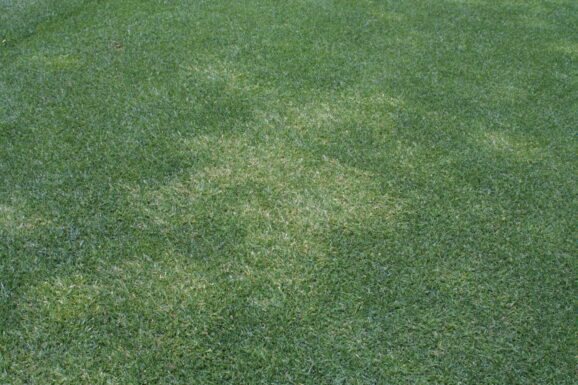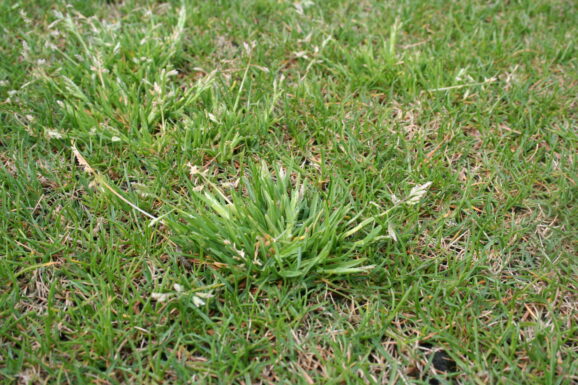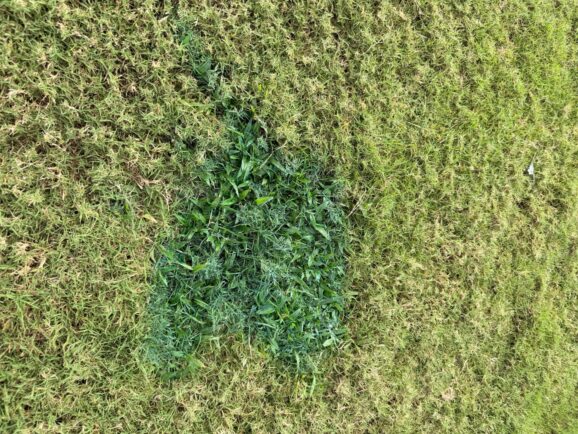
Dallisgrass is widely called the most difficult weed to control in the transition zone. Dallisgrass is a deep-rooted perennial that regrows from a crown your pre-emergent barrier never touches, and survives single herbicide applications that would kill an annual weed. This guide covers why dallisgrass beats the standard program, how to identify it compared to crabgrass, which post-emergent tools control versus suppress it, and how precise placement makes a multi-season fight winnable.
Key takeaways
- Dallisgrass is a perennial that stores carbohydrates in short, thick rhizomes and regrows from the crown, so a pre-emergent barrier does nothing to an established plant1.
- Control is a multi-season commitment: a single application suppresses regrowth but rarely kills a mature plant, which is why sequential applications across seasons are the norm2.
- Only one product family legally claims control of dallisgrass in warm-season turf, while several widely used options claim suppression, and the label wording is what decides which one you get.
- On tolerant species such as tall fescue and zoysiagrass, fluazifop can deliver strong control, though it injures many other desirable grasses.
- Monosodium methylarsonate (MSMA) is restricted to golf-course spot treatment under a treated-area cap, which makes precise placement a legal requirement rather than an efficiency choice3.
Why dallisgrass is one of the transition zone's hardest weed to control
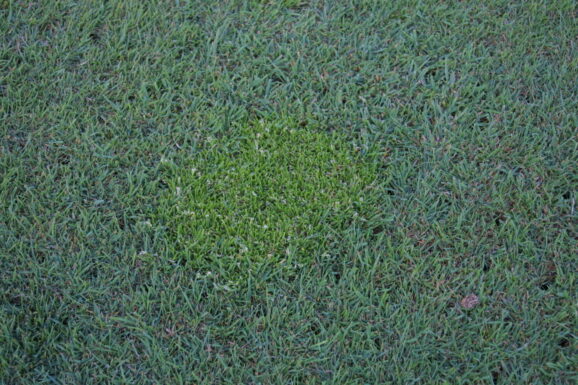
Dallisgrass (Paspalum dilatatum) is a warm-season perennial grass that behaves nothing like the summer annuals most turf programs are built to stop. Texas A&M AgriLife and Oklahoma State University extension programs describe it as one of the hardest weeds to control in the transition zone, because the climate lets it thrive year after year while the desirable turf sits under seasonal stress4. Three features make it so hard to remove.
- Carbohydrate-loaded crown: it stores reserves in short, thick rhizomes and a woody crown, and regrows from that crown after the top growth is removed or burned back5.
- No germination window: an established plant is already present and growing every season, so there is no seedling stage for a barrier to catch.
- Age and anchorage: the weed you see in July is often several years old, held by a root system that a soil-surface barrier cannot reach.
A herbicide that kills the visible leaf without reaching and depleting the crown buys a few weeks, then the plant pushes new growth from its reserves. That is the structural reason a single pass fails and a sustained program succeeds.
Dallisgrass vs crabgrass: identification that sets the strategy
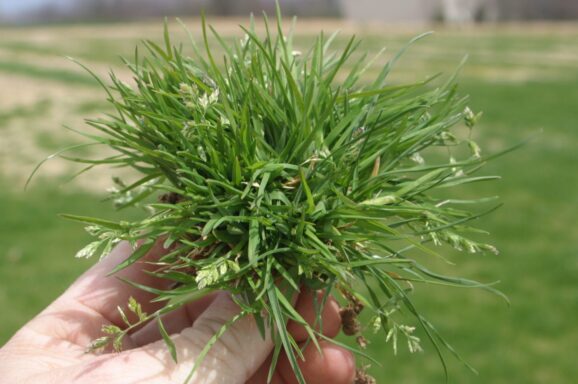
A mature dallisgrass plant and a mature crabgrass plant are easy to tell apart. The confusion happens at the young growth stages, where the two look close enough that a scouting pass, and sometimes a product label, treats one as the other. That early misidentification is what costs the season, because the two weeds demand opposite strategies.
Confirm which one you have before you commit a season of applications.
| Trait | Dallisgrass | Crabgrass |
| Life cycle | Perennial, returns from crown | Summer annual, dies at frost |
| Root system | Short thick rhizomes, woody crown | Fibrous, shallow |
| Growth pattern | Dense tufts from a central crown | Spreading, stems root at nodes |
| Seedhead | Sparse branches with black fringed spikelets | Finger spikes without black fringe |
| Pre-emergent effect | None on established plants | Controlled at germination |
The decisive difference is the life cycle. Crabgrass is a summer annual controlled at germination by a well-timed pre-emergent, so it responds to the barrier strategy that most programs already run. Dallisgrass is a perennial that a pre-emergent cannot reach once established, so it demands post-emergent chemistry placed on the growing plant over multiple seasons6. The dallisgrass seedhead settles the identification with its sparse branches and dark, fringed spikelets.
Reading the weed wrong costs a full season. A pre-emergent program aimed at a perennial dallisgrass plant treats ground where nothing is germinating while the established plant grows untouched.
Why pre-emergents fail on established dallisgrass
A pre-emergent herbicide forms a residual barrier in the top layer of soil and stops seeds as they germinate, so it can suppress new dallisgrass seedlings where seed is present. It does nothing to a plant that is already established7.
- Crown depth: the crown and rhizomes sit below and outside the treated layer, so the residual never contacts them.
- Regrowth from reserves: an established plant returns each year from stored carbohydrate, so a seed-stage barrier is irrelevant to it.
- Extension confirmation: Texas A&M and transition-zone programs confirm pre-emergent products will not control existing perennial dallisgrass plants8.
This is why the dallisgrass program inverts the usual turf logic. On annual weeds, the pre-emergent barrier does the heavy lifting and post-emergent chemistry cleans up escapes. On dallisgrass, post-emergent treatment is the program, and the barrier is at best a containment measure that holds seedling recruitment at the perimeter.
Post-emergent control: what controls versus what suppresses
The decisive distinction in a dallisgrass program is the label wording, because control and suppression are different outcomes and the label states which one a product delivers9. The general framework for matching a post-emergent to the weed and turf is covered in this post-emergent herbicide guide. The options divide by turf type.
- Warm-season control claim: the premix combining thiencarbazone, foramsulfuron and halosulfuron is the one that legally claims control of dallisgrass. What separates a control claim from a suppression claim is the combination of active ingredients in the premix, not a difference in concentration, so read the label of the specific product.
- Warm-season suppression claim: widely used options such as foramsulfuron alone, trifloxysulfuron, or thiencarbazone combinations often claim suppression rather than control.
- Tolerant species: on tolerant turf such as tall fescue and zoysiagrass, fluazifop can deliver strong control over a full season, though it injures bentgrass, ryegrass, and many other desirable grasses, so its use is confined to the surfaces that tolerate it.
- Non-selective spot treatment: spot treatment with non-selective herbicides is a viable option to control dallisgrass while maintaining turfgrass quality and playability.
Timing decides how much of that repetition pays. Fall applications move the herbicide into the rhizomes and crown before the plant overwinters, which is when translocation works in your favor, and a spring application then suppresses the new growth that survives.
Every effective post-emergent shares one requirement: repetition. A mature dallisgrass plant rarely dies from one application because the crown survives, so the program sequences treatments across the season and often across years, timing each pass to hit actively growing tissue that translocates herbicide down to the reserves. Treating a drought-stressed or dormant dallisgrass wastes the herbicide application.
MSMA and the spot-treatment constraint on golf turf
Monosodium methylarsonate (MSMA) is historically one of the most effective post-emergent tools against dallisgrass, and its US registration now restricts its turf use to golf courses, sod farms and highway rights-of-way under tight limits10. Those limits define how it can be used.
- Spot treatment only: applications are confined to defined small areas, which removes MSMA as a broadcast option entirely.
- Yearly acreage cap: treatment is capped at a 25% of the acres on the golf course per year, and a course that exceeds it is out of compliance regardless of the agronomic case.
That constraint reframes MSMA as a precision tool for isolated dallisgrass plants, applied plant by plant within the treated-area cap rather than as a broadcast treatment. The combination of a restricted high-efficacy tool and a perennial weed that clusters in discrete infestations points to the same conclusion as the chemistry: dallisgrass is a herbicide placement problem. The infestations are visible, countable, and stationary, which is exactly the pattern that rewards targeted treatment over broadcast spraying.
Resistance status and the case for rotation
Unlike goosegrass and annual bluegrass, dallisgrass has no widely documented cases of confirmed herbicide resistance on turf, so its current failures trace to biology and application rather than to genetics. The weed survives because the crown outlasts a single pass, not because it has evolved past the chemistry shaping the herbicide rotation program.
- Proven chemistry: with no confirmed resistance, the program can rely on the modes of action that work, as long as they reach the crown and are repeated.
- Rotation as insurance: the sulfonylurea chemistries that carry the dallisgrass program face resistance pressure from other turf weeds, so rotating Herbicide Resistance Action Committee (HRAC) groups across the broader weed spectrum protects the tools dallisgrass still responds to.
- Confirm suspected resistance: where a suspected failure looks like resistance rather than a missed crown, a Cooperative Extension test settles it before the program is rewritten.
The durable position is to treat dallisgrass as a biology problem first: reach the crown, repeat across seasons, and rotate modes of action to keep the effective products effective. For the neighboring grass pressures on the same surfaces, the goosegrass control program shares the same resistance logic.
Precision spot spraying for dallisgrass infestations
We believe a weed that grows in discrete infestations should never cost a whole fairway of chemistry. Dallisgrass makes that case better than any other transition-zone weed: the infestations are stationary, the above ground growth returns from the same crowns season after season, and every herbicide drop that lands between them does nothing to the infestation. A broadcast spray treats a whole fairway of clean turf to reach a scattered set of infestations, exposing desirable turfgrass to chemistry it does not need, while a targeted application treats only the the weed.
The ALBA ultra-high precision sprayer detects weeds from 4 mm, delivers a 3 cm² spray spot, and applies registered chemistry only to the plants it identifies. In turf trials, Ecorobotix reports 70 to 90% herbicide reduction with this approach while holding playing-surface quality, and the platform is proven across 500+ agricultural clients in 20+ countries and now adapted for turf11. For a weed that requires repeated seasonal passes on the same infestations, precise placement compounds across every treatment in the sequence, concentrating chemistry on the crown that has to be depleted.
Precision also changes which chemistry is usable. Because the sprayer treats identified plants rather than the surface, a program can pair a non-selective burner that takes down the above ground growth with a systemic herbicide that translocates into the rhizome and crown, which is the part that actually has to die. That combination is not an option in a broadcast application on a playing surface.
Precision also matters for an acreage capped herbicide. Where a program relies on spot-treatment chemistry limited to a share of the course, treating only the detected dallisgrass keeps the labeled acreage herbicide applied on actual dallisgrass rather than desired turfgrass.
The same precision logic supports broader efforts to reduce turf management costs without compromising quality, and Ecorobotix projects return on investment within three years through input and labor savings. Courses fighting an established infestation can request an on-course Turf Care audit that maps dallisgrass zone by zone before committing the season's program.
Building a dallisgrass program that holds
Dallisgrass is a perennial that regrows from a crown no pre-emergent can reach, so the program that holds is built on correct identification, post-emergent chemistry placed on the growing plant, and the patience to repeat it across seasons. Confirm the weed against crabgrass, accept that the pre-emergent herbicide barrier only contains seedling recruitment at the edges of new dallisgrass growth, choose products by their label wording of control versus suppression, and match the chemistry to the turf species that tolerates it.
The fight is won on repetition and placement. A mature dallisgrass takes multiple passes among seasons to deplete the crowns, MSMA is available only as an acreage capped spot treatment, and the weed presents as discrete infestations that reward targeted application over broadcast spraying. As the climate found in the transition zone keeps favoring this weed year over year, the courses that gain ground will be the ones that identify dallisgrass correctly, treat the crown on a multi-season schedule, and place every labeled pass exactly on the dallisgrass .
The first move is to map the dallisgrass before they seed and commit to a multi-season budget of control now, because a dallisgrass infestation only anchors deeper and costs more the longer it is left to grow.
FAQ
How do you tell dallisgrass from crabgrass?
Dallisgrass is a perennial that grows in dense tufts from a central crown, returns every year, and has short thick rhizomes and a sparse seedhead with dark, fringed spikelets. Crabgrass is a summer annual that spreads with stems rooting at the nodes, dies at frost, and has a fibrous shallow root system. The difference sets the strategy: crabgrass is controlled at germination by a pre-emergent, while dallisgrass demands post-emergent treatment on the established plant over multiple seasons.
Why do pre-emergent herbicides not control dallisgrass?
A pre-emergent herbicide forms a barrier in the top layer of soil and stops seeds as they germinate. An established dallisgrass plant regrows each year from its crown and rhizomes, not from seed, and those structures sit below and beyond the herbicide barrier. Extension programs state it directly: pre-emergent products will not control existing perennial dallisgrass plants. They can only suppress new seedlings where seed is present.
What is the best herbicide for dallisgrass on golf turf?
On warm-season turf, the product family combining thiencarbazone, foramsulfuron, and halosulfuron is the one that legally claims control, while several other options claim suppression instead. On tolerant species such as tall fescue and zoysiagrass, fluazifop can give strong control but injures many other grasses. Every effective option requires repeated applications across seasons, because a single pass rarely kills the crown.
Can you use MSMA for dallisgrass on a golf course?
Yes, but only as spot treatment within tight limits. MSMA is historically effective on dallisgrass, and its US registration limits its turf use to golf courses, sod farms and highway rights-of-way, confines it to defined small treated areas, and caps the maximum share of the course treated per year (25% of acreage). It is a targeted rescue for isolated dallisgrass, not a broadcast fairway treatment, and applications beyond the capped share are out of compliance.
How long does it take to control dallisgrass?
Plan for multiple seasons. Dallisgrass stores carbohydrate reserves in its crown and rhizomes, so a single herbicide pass suppresses regrowth without killing a mature plant. Sequential treatments timed to actively growing tissue gradually deplete the reserves, and full control of an established infestation typically takes repeated applications across a season and often across years.
- Texas A&M AgriLife Extension (consulted 2026). "Dallisgrass Control in Turfgrass". Publication ESC-038. https://aggieturf.tamu.edu/wp-content/uploads/sites/24/ESC-038_DallisgrassCont-cxd.pdf ↩︎
- Texas A&M AgriLife Extension (consulted 2026). "Dallisgrass Control in Turfgrass". Publication ESC-038. https://aggieturf.tamu.edu/wp-content/uploads/sites/24/ESC-038_DallisgrassCont-cxd.pdf ↩︎
- United States Environmental Protection Agency (EPA) (consulted 2026). "Monosodium Methanearsonate (MSMA), an Organic Arsenical". https://www.epa.gov/ingredients-used-pesticide-products/monosodium-methanearsonate-msma-organic-arsenical ↩︎
- Texas A&M AgriLife Extension (consulted 2026). "Dallisgrass Control in Turfgrass". Publication ESC-038. https://aggieturf.tamu.edu/wp-content/uploads/sites/24/ESC-038_DallisgrassCont-cxd.pdf ↩︎
- Texas A&M AgriLife Extension (consulted 2026). "Dallisgrass Control in Turfgrass". Publication ESC-038. https://aggieturf.tamu.edu/wp-content/uploads/sites/24/ESC-038_DallisgrassCont-cxd.pdf ↩︎
- Texas A&M AgriLife Extension (consulted 2026). "Dallisgrass Control in Turfgrass". Publication ESC-038. https://aggieturf.tamu.edu/wp-content/uploads/sites/24/ESC-038_DallisgrassCont-cxd.pdf ↩︎
- Texas A&M AgriLife Extension (consulted 2026). "Dallisgrass Control in Turfgrass". Publication ESC-038. https://aggieturf.tamu.edu/wp-content/uploads/sites/24/ESC-038_DallisgrassCont-cxd.pdf ↩︎
- Texas A&M AgriLife Extension (consulted 2026). "Dallisgrass Control in Turfgrass". Publication ESC-038. https://aggieturf.tamu.edu/wp-content/uploads/sites/24/ESC-038_DallisgrassCont-cxd.pdf ↩︎
- Texas A&M AgriLife Extension (consulted 2026). "Dallisgrass Control in Turfgrass". Publication ESC-038. https://aggieturf.tamu.edu/wp-content/uploads/sites/24/ESC-038_DallisgrassCont-cxd.pdf ↩︎
- United States Environmental Protection Agency (EPA) (consulted 2026). "Monosodium Methanearsonate (MSMA), an Organic Arsenical". https://www.epa.gov/ingredients-used-pesticide-products/monosodium-methanearsonate-msma-organic-arsenical ↩︎
- Ecorobotix (2026). "ALBA Ultra-High Precision Sprayer for Golf Turf". https://turf.ecorobotix.com/ ↩︎