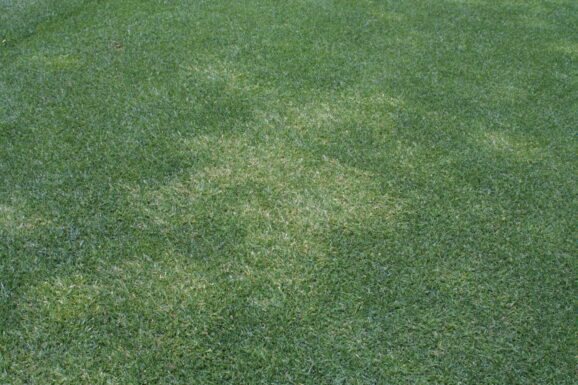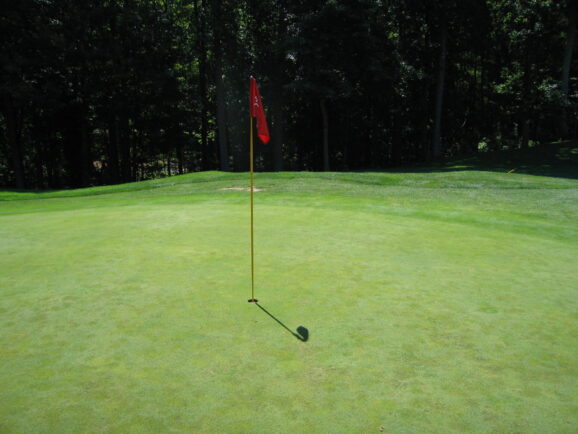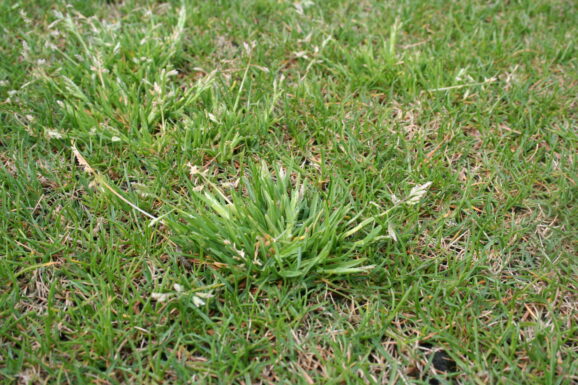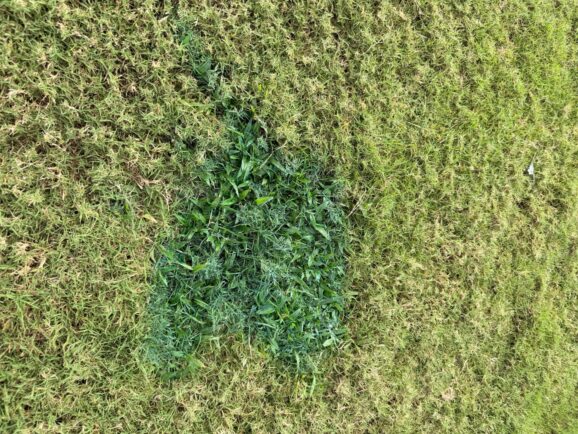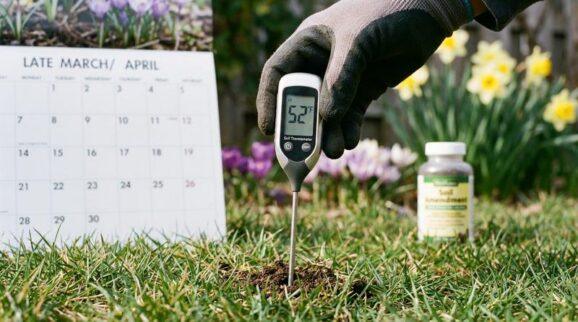
Goosegrass is one of the hardest summer annual weeds to control on a golf course because it germinates discontinuously, starting around 60 to 65 °F (16 to 18 °C) soil temperature and producing new flushes all summer instead of the single flush a barrier can cover1. It colonizes the compacted, close-mown ground your players walk most. This guide covers how to identify it, why it escapes the crabgrass program, which herbicides work by turf type, and how to manage the resistance documented on US courses2.
Key takeaways
- Goosegrass germinates discontinuously through the summer, starting at 60 to 65 °F (16 to 18 °C) soil temperature, so a single pre-emergent application cannot cover the whole emergence period3.
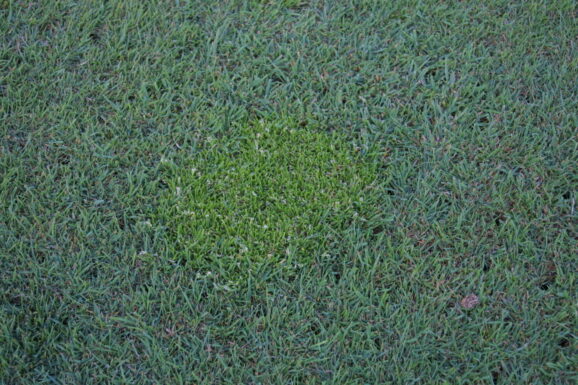
- It is a compaction indicator: it thrives on green surrounds, collars, approaches, and traffic paths where the soil is tight and the canopy is thin4.
- One plant can produce up to 50,000 seeds, which refills the seed bank faster than any single herbicide application can deplete5.
- Oxadiazon is the most-used pre-emergent for goosegrass, though its US label caps the treated area of a course, so placement discipline matters.
- Goosegrass populations resistant to dithiopyr are confirmed on Northeastern US golf courses, while oxadiazon still maintained above 85 percent control on the same plots6.
What goosegrass is and why it is a golf turfgrass pest
Goosegrass (Eleusine indica) is a warm-season summer annual grass that germinates in spring, matures through summer, and dies at the first hard frost. These three traits make it a recurring issue on golf turfgrass.
- Compaction tolerance: it roots into dense, low-oxygen soil that stresses desirable turf, so it appears first along cart paths, walk-off points, green entries, and bunker faces7.
- Low-mow survival: it grows in a flattened rosette that tolerates mowing heights far below what most weeds survive, which is why it persists on greens, collars and tightly cut approaches.
- Prolific seeding: a single plant can set up to 50,000 seeds in a season, replenishing a multi-year seed bank in the top layer of the soil profile8.
The United States Golf Association (USGA) frames goosegrass directly in the question of whether firm, fast conditioning invites goosegrass, because the same tight surfaces that reward playability also favor its establishment9. Each summer you let a cohort mature, you finance several seasons of future pressure, which is why the durable program targets goosegrass before it sets seed rather than cleaning up after.
Goosegrass vs crabgrass: the identification that changes your program
A mature goosegrass plant and a mature crabgrass plant are easy to tell apart. The misidentification happens at the seedling and early-tiller stages, on a fast scouting walk across a green surround, and that is exactly when the program is being set for the season. Get it wrong then and the timing, the herbicide and the whole calendar follow the wrong species.
Misidentification is a common and avoidable cause of failed applications, because goosegrass and crabgrass share a habitat but not a control window. Confirm the species before you build the program.
| Trait | Goosegrass | Crabgrass |
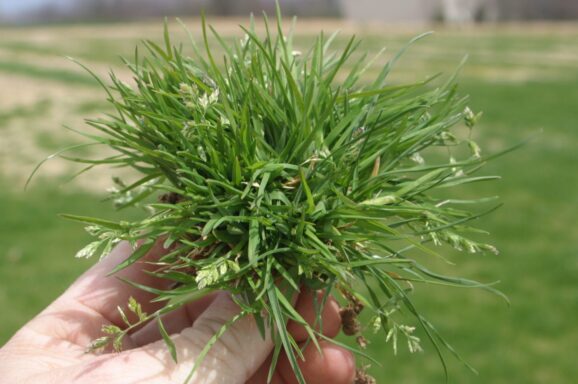
| Center of the plant | White to silver whorl | Green, no silver center |
| Growth habit | Flattened rosette, stems do not root at nodes | Spreading, stems root at the nodes |
| Leaf bud | Folded in the bud | Rolled in the bud |
| Seedhead | Zipper-like finger spikes | Finger spikes without the zipper seed pattern |
| Germination | 60 to 65 °F (16 to 18 °C) soil, repeated flushes | 55 °F (13 °C) soil, one earlier flush |
The white-to-silver center whorl is the fastest field tell, confirmed by the folded leaf bud and the flattened stems that do not root where they touch the soil10. Purdue and North Carolina State turf diagnostics both base the identification on those traits, and the seedhead settles any doubt with its distinctive zipper pattern along the finger spikes11.
The practical consequence is timing. Crabgrass and goosegrass germinate on different soil-temperature triggers, so a barrier built and timed for crabgrass is already thinning when goosegrass begins to germinate. Identify which weed you actually have before you decide when to spray.
Discontinuous germination: why goosegrass escapes the pre-emergent barrier
Goosegrass germinates when the soil warms to 60 to 65 °F (16 to 18 °C), and it keeps germinating in successive flushes through the summer rather than in one tight pulse12. That discontinuous emergence is the structural reason a standard crabgrass program leaves goosegrass an opening: no single application stays active long enough to meet every flush.
- Timed to the wrong trigger. Most pre-emergent applications target the earlier crabgrass trigger near 55 °F (13 °C) soil temperature.
- Decay before emergence ends. Several weeks of irrigation, microbial breakdown, and root-zone warmth drop the residual below the level goosegrass needs to be stopped, while new flushes are still coming.
Two adjustments close the gap. A longer-residual pre-emergent extends the barrier further into the season so it is still active when goosegrass begins to emerge. A split or sequential pre-emergent application refreshes the barrier between flushes. Both options trade a higher input cost against a summer post-emergent rescue on an already-established goosegrass, which is far harder to win.
Pre-emergent control: oxadiazon and the timing gap
Oxadiazon is among the pre-emergent options most used against goosegrass, as it controls goosegrass at germination and carries a residual long enough to cover the window that crabgrass-timed applications leave open. It is one option among several rather than the only route, and the program matters more than the herbicide. It is among the pre-emergents the USGA points superintendents toward for green surrounds and approaches where goosegrass pressure concentrates13. Two label realities shape how you apply oxadiazon:
- A treated-area cap. The US oxadiazon label limits the amount of a course that can be treated in a season and sets an annual active-ingredient ceiling per acre, so broadcast application across every at-risk surface is not an option even where agronomy would justify it.
- Placement sensitivity. The herbicide is most effectively placed exactly where goosegrass germinates, which on most courses is a predictable set of compacted, thin-canopy zones rather than whole fairways.
That combination, a strong herbicide with a treated-area cap and a habitat that clusters goosegrass, is what makes goosegrass as much a placement problem as a herbicide-selection problem. The superintendent who maps where goosegrass emerged last year and applies a capped herbicide on exactly those zones extracts more control per labeled acre than the one who spreads the same total volume thin across clean turf.
Post-emergent control by turf type
When goosegrass escapes the herbicide barrier, post-emergent control divides sharply by turf species, and the herbicide that is safe on one surface injures another.
Match the herbicide to the desirable grass first, then to its growth stage, because young goosegrass takes up herbicide far better than a mature summer plant. The general logic of matching herbicide to weed and turf is covered in this post-emergent herbicide guide.
On cool-season turf such as bentgrass, fescue, ryegrass, and Kentucky bluegrass, topramezone and fenoxaprop are the selective post-emergent options, applied to young, actively growing goosegrass and often applied in sequence because a single application rarely kills a mature plant.
On warm-season turf such as bermudagrass and zoysiagrass, foramsulfuron and metribuzin are the most effective post-emergent herbicides, with the same emphasis as in cool-season on treating goosegrass early.
Monosodium methylarsonate (MSMA) remains a historically effective post-emergent on goosegrass, though its US registration now restricts it to golf courses under a spot-treatment cap: applications are limited to small treated areas and to 25% of the acres on the golf course per year14. It is a targeted rescue herbicide for isolated escapes, not a program mainstay. A separate caution: glyphosate and glufosinate control goosegrass but are non-selective, so their turf use is confined to spot treatment on non-play areas and dormant warm-season stands, never as an in-bounds selective application.
Herbicide resistance in goosegrass
Goosegrass is on the list of turf weeds with confirmed, documented herbicide resistance on golf courses, which moves resistance management from a precaution to a working constraint.
A study of Northeastern US golf courses confirmed goosegrass populations resistant to dithiopyr, where the pre-emergent delivered near-zero control at labeled rates15. The resistance traced to a target-site mutation in goosegrass's tubulin, and on the same plots oxadiazon still maintained control above 85 percent16. Two lessons follow for the program.
First, a pre-emergent failure on goosegrass is not automatically a timing or coverage problem; on courses with a treatment history, resistance is a live possibility, and a Cooperative Extension test confirms it before you rebuild the program.
Second, resistance to one mode of action does not condemn the others, so rotating Herbicide Resistance Action Committee (HRAC) groups across seasons and avoiding back-to-back reliance on a single mode of action is what preserves the herbicides that still work.
HRAC group numbering is now aligned with the Weed Science Society of America (WSSA) classification, so the two systems classify the herbicides the same way.
University extension records document goosegrass biotypes resistant across several modes of action, including cases involving pre-emergent dinitroanilines and non-selective herbicides17. The operational answer is the same one that protects every intensively treated surface: rotate modes of action, confirm suspected resistance rather than assuming it, and lower the total selection pressure you apply to any single group.
Precision spot spraying for goosegrass
We believe the courses that stay ahead of goosegrass will be the ones that stop treating surfaces and start treating plants. The active ingredients that still work on goosegrass are a finite inheritance, not a renewable input, and a season of flushes met plant by plant is what leaves something on the label for the season after.
An area-capped herbicide should be applied where goosegrass is, not where the sprayer happens to pass. Goosegrass makes that arithmetic plain: it concentrates in patches along compaction and traffic paths rather than spreading evenly, so treating the whole surface to reach clustered goosegrass wastes herbicide on clean turf, and on an area capped herbicide like oxadiazon it also uses up label-limited acreage where none grows.
The ALBA ultra-high precision sprayer detects weeds from 4 mm, delivers a 3 cm² spray spot, and applies registered herbicide only to the plants it identifies. For an area capped pre-emergent herbicide, that precision means the labeled active-ingredient budget concentrates on the compaction zones where goosegrass actually germinates rather than spreading thin across surfaces that carry none.
In turf trials, Ecorobotix reports 70 to 90% herbicide reduction with this approach while maintaining playing-surface quality, and the platform is proven across 500+ agricultural clients in 20+ countries and now adapted for turf18. Concentrating the spray on the plants themselves is what makes the area capped herbicide stretch across a season without leaving escapes untreated.
Lowering the total field rate of an active ingredient also applies less selection pressure on any single HRAC group, which extends the working life of the herbicides that still control goosegrass. The same precision logic supports broader efforts to reduce turf management costs without compromising quality, and Ecorobotix projects return on investment within three years through input and labor savings. Courses scoping the fit can request an on-course Turf Care audit that maps goosegrass pressure zone by zone before the next germination window.
Building a goosegrass program that lasts
Goosegrass is a compaction-driven summer annual that germinates in successive flushes, which is why it outlives any single pre-emergent barrier, and it has already proved resistant to dithiopyr on some US courses. The program that lasts is built on identification, timing, and placement rather than on one herbicide: confirm the species, extend or split the pre-emergent barrier to cover the later flushes, apply oxadiazon within its treated-area cap, relieve the compaction that invites goosegrass, and keep post-emergent herbicides in reserve for young escapes.
As resistance narrows the options season over season, the courses that stay ahead will be the ones that rotate modes of action deliberately and place every labeled acre where the pressure actually sits. The practical next step is to map this season's escapes before they set seed, then request an on-course Turf Care audit that turns that map into next year's placement plan.
FAQ
How do you tell goosegrass from crabgrass?
Look at the center of the plant first: goosegrass has a white-to-silver whorl at its base, while crabgrass does not.
- Growth habit: goosegrass forms a flattened rosette with stems that do not root where they touch the soil; crabgrass spreads with stems that root at the nodes.
- Leaf bud: folded in goosegrass, rolled in crabgrass.
- Seedhead: goosegrass carries a distinctive zipper pattern along the finger spikes.
The identification matters because the two weeds germinate on different soil-temperature triggers and need different application timing.
Why does goosegrass escape my crabgrass pre-emergent?
Because goosegrass does not germinate in one flush: it starts around 60 to 65 °F (16 to 18 °C) soil temperature and keeps producing new flushes through the summer, while the barrier was timed for the earlier crabgrass trigger near 55 °F (13 °C) and is already degrading when the first goosegrass appears.
- A longer-residual herbicide extends the barrier further into the season.
- A split or sequential application refreshes it between flushes.
The same soil-temperature discipline drives the annual bluegrass pre-emergent program in the opposite season.
What is the best pre-emergent for goosegrass on golf turf?
Oxadiazon is the most-used pre-emergent for goosegrass on golf courses, because it controls goosegrass at germination and carries a residual long enough to cover the later germination window. Its US label caps the treated area of the course and the annual active-ingredient rate per acre, so it works best placed on the compaction and traffic zones where goosegrass actually concentrates rather than applied across whole fairways.
Is goosegrass resistant to herbicides?
Yes, on some US golf courses.
- Populations resistant to dithiopyr are confirmed on Northeastern US courses, where dithiopyr gave near-zero control while oxadiazon maintained above 85 percent in the same trial.
- Extension records also document biotypes resistant to other modes of action.
- Confirm suspected resistance with a Cooperative Extension test before rebuilding the program, then rotate HRAC groups to protect the herbicides that still work.
Can you spot-spray goosegrass instead of treating the whole surface?
Yes, and it fits goosegrass better than a broadcast application, because goosegrass clusters in patches along compaction and traffic paths rather than spreading evenly.
- Precision spot spraying treats only the detected plants, saving herbicide on clean turf and concentrating a capped pre-emergent like oxadiazon where goosegrass germinates.
- The ALBA sprayer applies registered herbicide only to identified plants, and Ecorobotix reports 70 to 90% herbicide reduction in turf trials.
- North Carolina State Extension (consulted 2026). "Goosegrass". NC State TurfFiles. https://content.ces.ncsu.edu/goosegrass ↩︎
- United States Golf Association (USGA) Green Section (consulted 2026). "A Guide to Goosegrass Control". USGA Green Section Record. https://www.usga.org/content/usga/home-page/course-care/green-section-record/63/issue-04/a-guide-to-goosegrass-control.html ↩︎
- North Carolina State Extension (consulted 2026). "Goosegrass". NC State TurfFiles. https://content.ces.ncsu.edu/goosegrass ↩︎
- McCullough, P.E. et al. (2022). "Dithiopyr-resistant goosegrass (Eleusine indica) on golf courses". Pest Management Science. https://pmc.ncbi.nlm.nih.gov/articles/PMC9293289/ ↩︎
- United States Golf Association (USGA) Green Section (consulted 2026). "A Guide to Goosegrass Control". USGA Green Section Record. https://www.usga.org/content/usga/home-page/course-care/green-section-record/63/issue-04/a-guide-to-goosegrass-control.html ↩︎
- North Carolina State Extension (consulted 2026). "Goosegrass". NC State TurfFiles. https://content.ces.ncsu.edu/goosegrass ↩︎
- United States Golf Association (USGA) Green Section (consulted 2026). "A Guide to Goosegrass Control". USGA Green Section Record. https://www.usga.org/content/usga/home-page/course-care/green-section-record/63/issue-04/a-guide-to-goosegrass-control.html ↩︎
- Purdue University Turfgrass Science (consulted 2026). "Goosegrass Identification". Purdue Turf. https://turf.purdue.edu/goosegrass/ ↩︎
- Purdue University Turfgrass Science (consulted 2026). "Goosegrass Identification". Purdue Turf. https://turf.purdue.edu/goosegrass/ ↩︎
- North Carolina State Extension (consulted 2026). "Goosegrass". NC State TurfFiles. https://content.ces.ncsu.edu/goosegrass ↩︎
- United States Golf Association (USGA) Green Section (consulted 2026). "A Guide to Goosegrass Control". USGA Green Section Record. https://www.usga.org/content/usga/home-page/course-care/green-section-record/63/issue-04/a-guide-to-goosegrass-control.html ↩︎
- University of Tennessee Institute of Agriculture (consulted 2026). "Goosegrass Control in Turf". Publication W243. https://utia.tennessee.edu/publications/ ↩︎
- McCullough, P.E. et al. (2022). "Dithiopyr-resistant goosegrass (Eleusine indica) on golf courses". Pest Management Science. https://pmc.ncbi.nlm.nih.gov/articles/PMC9293289/ ↩︎
- McCullough, P.E. et al. (2022). "Dithiopyr-resistant goosegrass (Eleusine indica) on golf courses". Pest Management Science. https://pmc.ncbi.nlm.nih.gov/articles/PMC9293289/ ↩︎
- University of Florida IFAS Extension (consulted 2026). "Goosegrass Biology and Management in Turf". Publication AG483. https://edis.ifas.ufl.edu/ ↩︎
- Ecorobotix (2026). "ALBA Ultra-High Precision Sprayer for Golf Turf: Product Overview and Field Validation Data". https://turf.ecorobotix.com/ ↩︎